


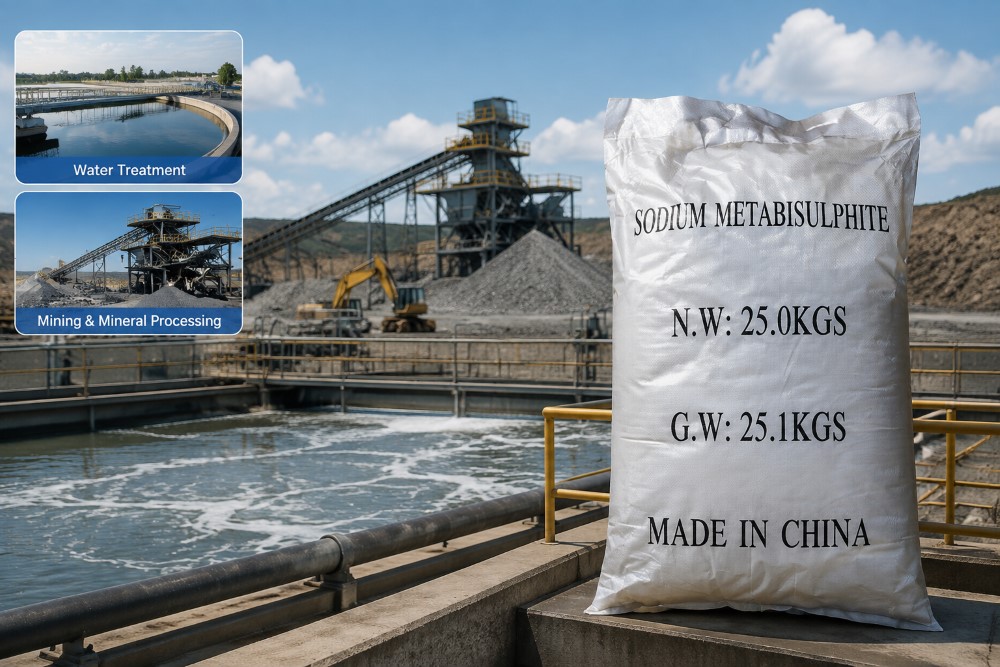
As mining operations across Southeast Asia—particularly in Indonesia, Vietnam, and the Philippines—expand, procurement and metallurgy teams face a common technical challenge: “When sourcing industrial-grade sodium metabisulfite for mineral processing, what key technical parameters distinguish mining-grade reagents from general industrial chemicals, and how do these specifications impact recovery rates and compliance?”
Sodium metabisulfite plays a vital role in mineral flotation, precious metal precipitation, and tailings detoxification. However, evaluating SMBS purely on unit price or standard purity percentage can lead to process inefficiencies, reagent wastage, or regulatory non-compliance.
This technical guide outlines the chemical mechanisms of SMBS in mining, the critical specifications required for mineral processing, and key procurement criteria for large-scale mining operations.
Mining Grade Sodium Metabisulfite: Applications, Specifications, and Procurement Guide
Why Is Sodium Metabisulfite Demand Increasing in Southeast Asian Mining?
The rapid growth of the mining and mineral processing industries in Southeast Asia has increased demand for high-performance chemical reagents. Countries such as Indonesia and Vietnam are expanding nickel, copper, and gold processing operations, creating greater requirements for a reliable sodium metabisulfite (SMBS) supply.
Mining operations use sodium metabisulfite (Na₂S₂O₅) as a sulfur dioxide (SO₂) source in mineral processing, flotation separation, and cyanide detoxification applications.
Unlike general industrial chemicals, mining-grade sodium metabisulfite requires higher purity, lower impurities, and consistent dissolution performance to support continuous processing systems.
Sodium Metabisulfite Applications in Mining Operations
1. Flotation Separation for Nickel and Copper Processing
Nickel and copper beneficiation plants rely on flotation technology to separate valuable minerals from unwanted components.
During sulfide mineral flotation, sodium metabisulfite acts as a selective depressant for minerals such as pyrite (FeS₂) and sphalerite (ZnS).
By controlling unwanted mineral reactions, SMBS helps improve concentrate quality and supports more efficient copper and nickel recovery processes.
2. Gold Mining Cyanide Detoxification
Gold extraction commonly uses cyanide leaching processes to dissolve precious metals from ore.
Before mine tailings are discharged, mining facilities must reduce toxic Weak Acid Dissociable (WAD) cyanide levels to comply with environmental requirements.
The widely used INCO SO₂/Air detoxification process applies sulfur dioxide, oxygen, and copper catalysts to convert cyanide (CN⁻) into less toxic cyanate (CNO⁻).
The chemical reaction can be represented as:
Because liquid sulfur dioxide requires specialized storage equipment and strict handling procedures, many mining operations choose solid sodium metabisulfite as a safer and easier-to-transport SO₂ source.
Mining Grade vs Industrial Grade Sodium Metabisulfite
Not all sodium metabisulfite products meet mining requirements. Mineral processing applications require tighter chemical control to maintain stable reagent performance.
| Specification | Industrial Grade SMBS | Mining Grade SMBS |
|---|---|---|
| Active Purity | 95.0%–96.5% | ≥97.0%–98.0% |
| Available SO₂ | Around 64% | ≥65.5% |
| Water Insoluble Matter | ≤0.05% | ≤0.01%–0.02% |
| Iron Content | ≤50 ppm | ≤15–20 ppm |
| Dissolution Performance | Standard dissolution | Fast dissolution with low dust |
| Anti-Caking Performance | Optional | Required for humid environments |
Key Quality Factors for Mining Grade SMBS
Low Water Insoluble Content Prevents Equipment Problems
Large mining operations often use automated reagent dosing systems.
Excess insoluble particles may cause:
- Pump abrasion
- Pipeline blockage
- Filter clogging
- Unstable chemical dosing
Therefore, mining-grade sodium metabisulfite requires strict insoluble matter control, typically below 0.02%.
Low Iron Content Protects Flotation Performance
Trace metal impurities can affect mineral surface chemistry during flotation.
High iron content may interfere with selective separation processes and reduce reagent efficiency.
For this reason, mining applications typically require controlled iron levels below 20 ppm.
Fast Dissolution Improves Automated Dosing
Modern mineral processing plants prepare reagents in continuous dissolution systems.
Free-flowing SMBS crystals dissolve quickly and generate less airborne dust compared with fine powders.
This improves:
- Operator safety
- Mixing efficiency
- Automated dosing accuracy
Mining SMBS vs Water Treatment SMBS: Procurement Differences
Different industries require different sodium metabisulfite performance characteristics.
| Procurement Factor | Mining Application | Water Treatment Application |
|---|---|---|
| Primary Function | SO₂ generation, flotation control, cyanide detoxification | Chlorine removal and oxygen control |
| Supply Volume | Large continuous supply | Small to medium batch supply |
| Stability Requirement | Extremely high batch consistency | Moderate consistency |
| Packaging | 1,000kg moisture-resistant bulk bags | Standard 25kg bags |
| Supply Priority | Continuous mine operation | Flexible replenishment |
How to Select a Mining Grade Sodium Metabisulfite Supplier
Mining companies should evaluate SMBS manufacturers based on several technical and supply chain factors.
1. Verify Available SO₂ Content
Qualified suppliers should provide batch testing documentation confirming available SO₂ levels.
Mining contracts commonly require:
- Available SO₂ ≥65.5%
- Consistent purity between production batches
2. Confirm Moisture Protection Packaging
Sodium metabisulfite can absorb moisture during transportation and storage.
For Southeast Asian mining environments, suppliers should provide:
- Multi-layer polyethylene liners
- Moisture-resistant packaging
- Anti-caking protection
These measures help prevent product degradation and ensure stable performance.
3. Evaluate Batch Consistency and Quality Control
Mining facilities depend on accurate chemical dosing systems.
Stable SMBS quality helps prevent:
- Underdosing risks
- Environmental compliance issues
- Unnecessary chemical consumption
Suppliers should provide:
- Certificate of Analysis (COA)
- Batch tracking
- Quality inspection records
4. Ensure Reliable Supply Capability
Large mining operations require uninterrupted chemical availability.
A reliable sodium metabisulfite supplier should offer:
- Stable production capacity
- Flexible shipment schedules
- Regional inventory support
Technical Summary
Mining operations require sodium metabisulfite with higher purity, lower impurities, and stronger consistency than standard industrial applications.
Selecting mining-grade sodium metabisulfite helps improve flotation performance, support cyanide detoxification processes, and maintain reliable automated reagent dosing systems.
SXS manufactures and supplies high-purity sodium metabisulfite (Na₂S₂O₅) for mining companies, mineral processing plants, gold extraction operations, and industrial water treatment applications worldwide.