


Industrial water treatment plants, reverse osmosis (RO) operators, and chemical procurement teams rely on sodium metabisulfite (SMBS, Na₂S₂O₅) as an essential reducing agent for purification systems.
Thin-film composite (TFC) polyamide RO membranes provide excellent salt rejection performance, but they are highly sensitive to oxidizing agents such as free chlorine. Even low chlorine exposure can damage the membrane structure, reduce rejection efficiency, and increase replacement costs.
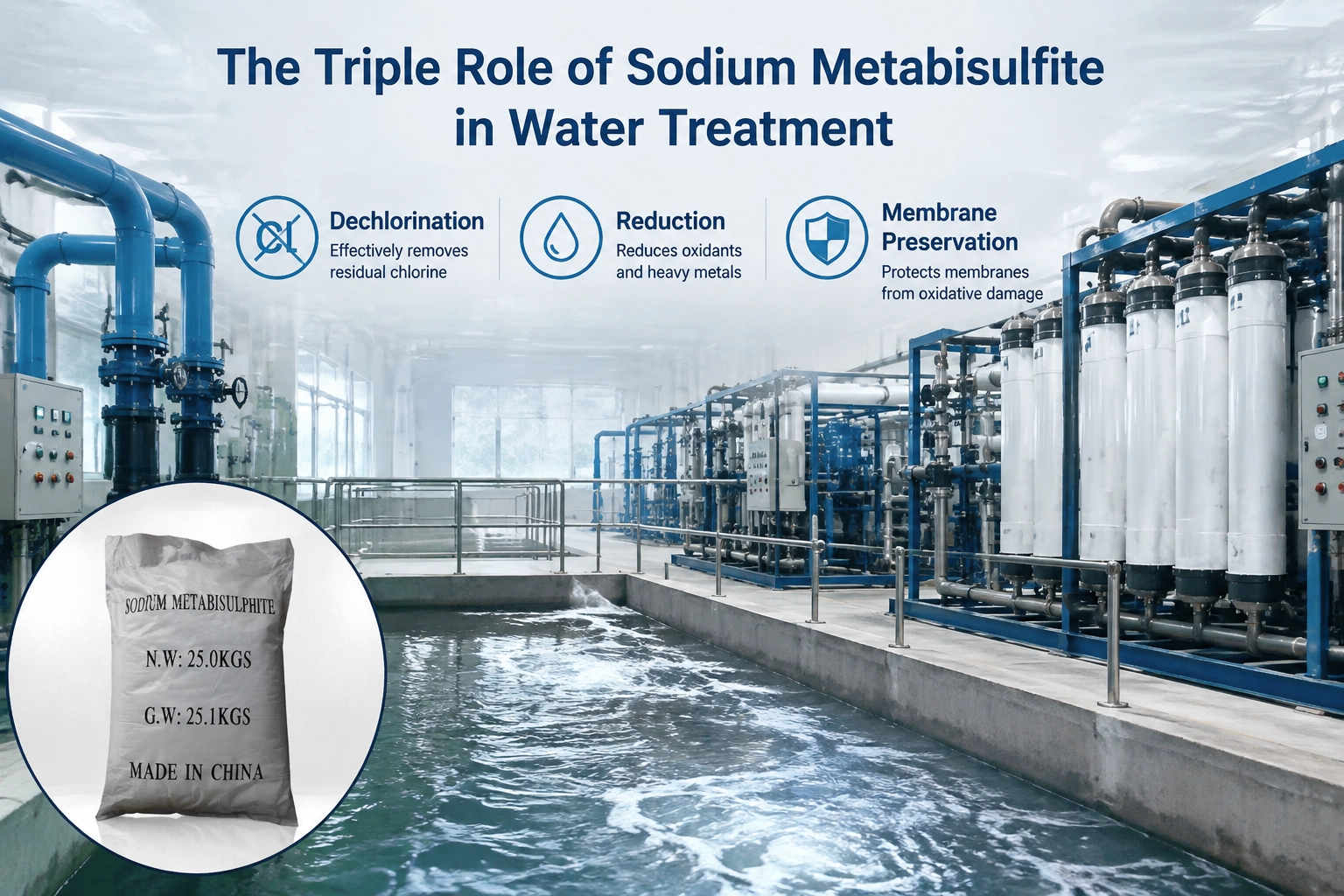
Therefore, sodium metabisulfite water treatment applications mainly focus on three critical functions:
- Removing residual chlorine before RO filtration.
- Reducing toxic heavy metals during wastewater treatment.
- Preserving RO membranes during long-term system shutdowns.
Understanding SMBS chemical reactions, dosing requirements, and storage conditions helps engineers improve system reliability and reduce operational risks.
1. Three Major Applications of Sodium Metabisulfite in Water Treatment
1. SMBS as a Dechlorination Chemical for RO Membrane Protection
The primary application of sodium metabisulfite in RO systems is chlorine removal.
Polyamide RO membranes have limited oxidation resistance. Free chlorine (HOCl/OCl⁻) attacks the amide bonds within the membrane layer, causing irreversible oxidation and permanent performance loss.
When dissolved in water, sodium metabisulfite converts into sodium bisulfite:
The generated bisulfite reacts with hypochlorous acid:
This reaction converts harmful chlorine into harmless chloride compounds.
Recommended SMBS Dosage for Chlorine Removal
The theoretical requirement is:
- 1.34 mg SMBS neutralizes 1.0 mg free chlorine
However, industrial RO systems usually apply additional safety margins.
Recommended operating dosage:
- 2.0–3.0 mg SMBS per 1.0 mg free chlorine
This compensates for dissolved oxygen and other oxidizing substances in the feed water.
2. Sodium Metabisulfite as a Heavy Metal Reducing Agent
In industrial wastewater treatment, SMBS works as an electron donor to reduce toxic metals.
A common application is chromium treatment.
Hexavalent chromium (Cr⁶⁺) has high toxicity and requires chemical reduction before removal.
Under acidic conditions:
SMBS converts Cr⁶⁺ into less harmful trivalent chromium (Cr³⁺).
After increasing the pH above 8.5, Cr³⁺ forms chromium hydroxide precipitation:
This allows wastewater facilities to separate chromium from treated water more effectively.
3. SMBS for RO Membrane Storage and Preservation
During extended RO system shutdowns, stagnant water creates conditions for bacterial growth and biofilm formation.
A sodium metabisulfite preservation solution helps protect RO membranes by:
- Removing dissolved oxygen.
- Creating a mildly acidic environment.
- Reducing microbial activity.
Typical preservation concentration:
- 1.0%–1.5% SMBS solution
- Recommended storage pH: 3.5–4.5
This method helps maintain membrane performance during shutdown periods longer than 48–72 hours.
4. SMBS Dosing System Design for RO Applications
Reliable chlorine removal requires correct injection location, complete mixing, and continuous monitoring.
Recommended SMBS Injection Control Process
| Engineering Parameter | Recommended Practice | Purpose |
|---|---|---|
| Injection Location | After cartridge filter and before high-pressure RO pump | Protects filters while preventing chlorine exposure to membranes |
| Mixing System | Inline static mixer or turbulent pipeline section | Ensures rapid chemical reaction |
| ORP Monitoring | Install downstream ORP sensors | Confirms complete chlorine removal |
| Chemical Filtration | Use 5-micron dosing line filters | Prevents undissolved particles entering RO equipment |
5. ORP Monitoring and Chemical Control
Although the SMBS and chlorine reaction occurs within seconds, proper mixing remains essential.
An inline static mixer prevents chemical channeling and improves contact efficiency.
ORP monitoring provides real-time verification:
- +175 to +250 mV: Indicates effective chlorine removal.
- Above +300 mV: May trigger protective shutdown actions.
This control strategy prevents oxidant breakthrough and protects expensive RO membranes.
6. Sodium Metabisulfite Solution Stability and Storage
Proper chemical handling directly affects SMBS dosing accuracy.
| Parameter | Dry SMBS Powder | Liquid SMBS Solution |
|---|---|---|
| Storage Life | 4–6 months in sealed dry conditions | Usually 1–7 days after preparation |
| Stability Factor | Sensitive to humidity | Sensitive to oxygen exposure |
| Recommended Concentration | Bulk storage | 2%–10% solution |
| Main Risk | Moisture absorption | Oxidation and activity loss |
| Storage Method | Dry sealed container | Covered chemical tank |
The oxidation reaction is:
This converts active sulfite into inactive bisulfate.
For large-scale RO plants, nitrogen-blanketed tanks can improve solution stability.
7. How to Select High-Purity Sodium Metabisulfite for Water Treatment
Chemical quality directly affects RO membrane lifespan.
Choose High-Purity SMBS Grade
Water treatment applications should prioritize:
- Purity ≥98%.
- Food-grade or high-purity specifications.
- Cobalt-free formulation.
Industrial chemicals designed for mining or paper production may contain trace metals.
Certain transition metals can accelerate oxidation reactions and damage polyamide RO membranes.
Verify Water Treatment Compliance
For municipal and drinking water applications, suppliers should provide:
- NSF/ANSI Standard 60 compliance documentation.
- Batch quality certificates.
- Purity analysis reports.
These certifications help ensure chemical safety and consistent treatment performance.
Technical Summary
Sodium metabisulfite plays an important role in modern water treatment systems as a dechlorination chemical, heavy metal reducing agent, and RO membrane preservation solution.
By controlling SMBS dosage, optimizing injection points, monitoring ORP values, and selecting high-purity cobalt-free chemicals, engineers can reduce membrane oxidation risks and improve long-term RO system reliability.
SXS provides high-purity sodium metabisulfite solutions designed for reverse osmosis pretreatment, industrial water purification, and municipal water treatment applications.