


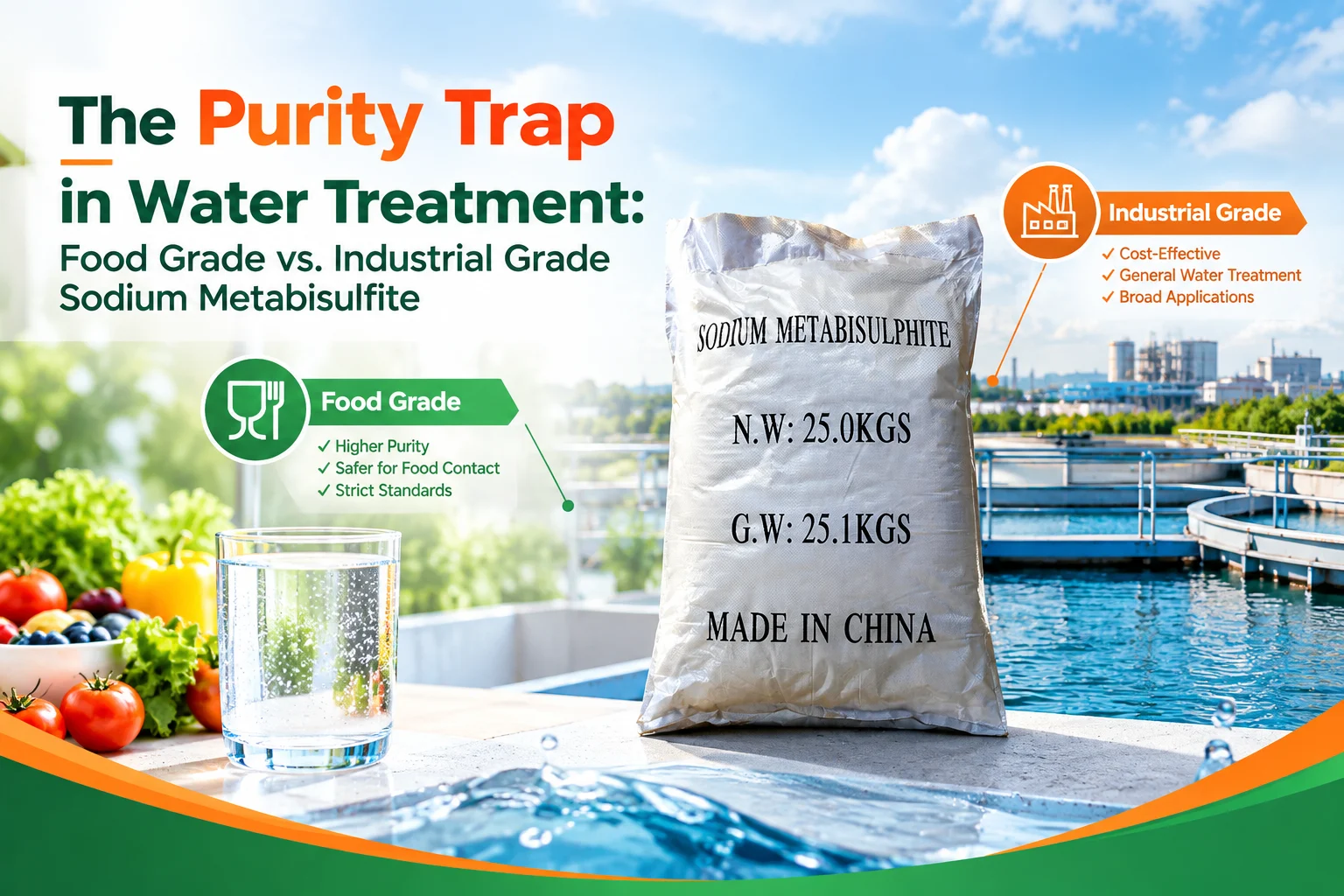
In municipal water treatment and industrial Reverse Osmosis (RO) plants, sodium metabisulfite is widely used for residual chlorine removal and dissolved oxygen scavenging.
However, choosing sodium metabisulfite for water treatment based only on its assay purity can create hidden risks.
Industrial-grade sodium metabisulfite may have a lower purchase price, but uncontrolled trace impurities can affect RO membrane performance, treated water quality, and regulatory compliance.
For high-consequence water purification systems, the key question is not simply how much sodium metabisulfite is present. Buyers should also evaluate impurity limits, certification, batch traceability, and total operating cost.
Food Grade vs. Industrial Grade Sodium Metabisulfite
The difference between industrial and food grade sodium metabisulfite extends beyond the main chemical assay.
Trace levels of heavy metals, iron, and arsenic can become important when the chemical is continuously dosed into RO pretreatment or potable water systems.
| Specification Parameter | Industrial Grade Na₂S₂O₅ | Food Grade / NSF 60 Certified Na₂S₂O₅ | Water Treatment Impact |
|---|---|---|---|
| Main Assay Purity | Typically 95.0%–97.0% | ≥98.0% | Higher active SO₂ concentration per kilogram |
| Heavy Metals as Pb | ≤50 ppm or unmonitored | ≤10 ppm | Reduces heavy metal accumulation |
| Iron Fe Content | Up to 15–20 ppm | ≤2 ppm | Reduces iron-related RO membrane fouling |
| Arsenic As Content | ≤5 ppm | ≤1 ppm | Supports strict drinking water requirements |
| Regulatory Certification | Basic ISO manufacturing standards | NSF/ANSI 60 Certified | Supports potable water treatment compliance |
Why Assay Purity Is Not Enough
A higher assay percentage does not automatically describe the complete quality profile of a water treatment chemical.
For continuous dosing systems, even low concentrations of unwanted elements can accumulate through repeated chemical addition.
Therefore, procurement teams should review both:
- Main assay purity
- Heavy metal limits
- Iron content
- Arsenic content
- Certification status
- Batch-specific Certificate of Analysis (COA)
This distinction becomes particularly important for RO pretreatment and municipal drinking water systems.
3 Critical Risks of Industrial Grade Sodium Metabisulfite
Using uncertified industrial-grade stock in high-consequence water treatment applications can create three major risks.
1. Reverse Osmosis Membrane Fouling
Industrial-grade sodium metabisulfite may contain higher levels of trace iron and other impurities.
When the chemical is continuously injected upstream of polyamide thin-film composite (TFC) RO membranes, iron-related precipitation can contribute to membrane fouling.
The relevant precipitation pathway is commonly represented as:
Fe³⁺ + 3OH⁻ → Fe(OH)₃↓
Ferric hydroxide can form deposits that contribute to colloidal or particulate fouling.
The operational consequences may include:
- Increased differential pressure (ΔP)
- Reduced permeate flux
- More frequent cleaning
- Shortened membrane service life
- Higher RO operating costs
This is why iron content should be evaluated when selecting sodium metabisulfite for water treatment, especially for continuous RO pretreatment.
2. Heavy Metal Accumulation and Secondary Contamination
Municipal water treatment systems can operate continuously for long periods.
Chemical additives are therefore introduced repeatedly into the treatment process.
If the chemical contains elevated levels of lead or arsenic, continuous dosing creates a potential source of secondary contamination.
The original comparison highlights:
- Lead as Pb: industrial grade ≤50 ppm or potentially unmonitored
- Lead as Pb: food grade / NSF 60 certified ≤10 ppm
- Arsenic as As: industrial grade ≤5 ppm
- Arsenic as As: food grade / NSF 60 certified ≤1 ppm
For potable water applications, these trace impurity differences can become more important than the initial price difference between chemical grades.
3. NSF/ANSI 60 Compliance Risk
For municipal drinking water applications, chemical certification is an important procurement criterion.
NSF/ANSI 60 covers drinking water treatment chemicals and evaluates their potential health effects.
Uncertified industrial grade chemicals may not provide the same level of documented health-effect validation and batch-level traceability required by regulated potable water applications.
Therefore, procurement teams should not evaluate sodium metabisulfite only by:
Price per kilogram × chemical purity
They should also consider:
Certification + impurity limits + COA traceability + operational risk
This provides a more complete basis for chemical selection.
How Sodium Metabisulfite Supports Water Treatment
Sodium metabisulfite is commonly used as a reducing agent in water treatment.
Its two key functions in the original application are:
Residual Chlorine Removal
Sodium metabisulfite reacts with residual chlorine before water reaches sensitive RO membranes.
This dechlorination step helps protect polyamide TFC membranes from oxidative damage.
Dissolved Oxygen Scavenging
Sodium metabisulfite can also act as an oxygen scavenger.
This makes it useful in treatment processes where dissolved oxygen control is required.
Because dosing occurs continuously, the chemical quality itself becomes part of the overall treatment process.
Why Food Grade or NSF/ANSI 60 Certified Grade Can Reduce TCO
A lower purchase price does not necessarily mean a lower treatment cost.
Consider the broader total cost of ownership (TCO):
Chemical price → membrane fouling → CIP frequency → membrane replacement → compliance risk
Industrial-grade sodium metabisulfite may appear attractive during initial procurement.
However, higher impurity levels can increase the potential for:
- RO membrane fouling
- Increased CIP frequency
- Reduced membrane lifespan
- Additional water quality monitoring
- Compliance problems
- Unplanned operating costs
Therefore, chemical procurement should compare total treatment cost, rather than simply comparing the price per kilogram.
Sodium Metabisulfite Procurement Checklist for Water Treatment
Before purchasing sodium metabisulfite for RO or municipal water treatment, buyers should verify the following specifications.
| Procurement Item | What to Check |
|---|---|
| Assay Purity | Main Na₂S₂O₅ content |
| Heavy Metals | Lead and other trace metal limits |
| Iron | Fe concentration and specification |
| Arsenic | As concentration and specification |
| Certification | NSF/ANSI 60 status where required |
| COA | Lot-specific Certificate of Analysis |
| Application | RO pretreatment, municipal water, process water, etc. |
| Total Cost | Chemical cost plus membrane and maintenance costs |
What Buyers Should Request From Suppliers
For high-consequence water treatment systems, procurement teams should request:
- Current product specification sheet.
- Relevant certification documentation.
- Lot-specific COA.
- Heavy metal analysis.
- Iron and arsenic test results.
- Recommended dosing information.
- Packaging and storage specifications.
This documentation helps buyers distinguish a genuinely suitable water treatment chemical from a lower-cost industrial material with insufficient traceability.
Food Grade vs. Industrial Grade: Which Should Buyers Choose?
The appropriate grade depends on the application and regulatory requirements.
Industrial Water Treatment
Industrial grade sodium metabisulfite can support applications that do not require potable water certification when its impurity profile meets system requirements. Therefore, buyers should verify the product specifications and impurity limits before purchasing.
RO Pretreatment
RO systems require particular attention to membrane protection.
Iron and other trace impurities should therefore be reviewed alongside the dechlorination performance of the chemical.
Municipal Drinking Water
For potable water applications, certification and health-effect requirements become critical.
The original comparison recommends NSF/ANSI 60 certified sodium metabisulfite supported by lot-specific COA documentation for these applications.
Key Takeaways
However, buyers should look beyond the percentage on the product specification because food grade and industrial grade sodium metabisulfite differ in more than purity.
For sodium metabisulfite for water treatment, buyers should evaluate the complete quality and compliance profile.
- Assay purity: Food grade / NSF 60 certified material is listed at ≥98.0% in the comparison.
- Heavy metals: The comparison gives ≤10 ppm as Pb for food grade / NSF 60 certified material.
- Iron: The comparison gives ≤2 ppm Fe, compared with up to 15–20 ppm for industrial grade.
- Arsenic: The comparison gives ≤1 ppm As, compared with ≤5 ppm for industrial grade.
- Certification: NSF/ANSI 60 certification is a key consideration for potable water treatment.
- Documentation: Lot-specific COA records provide important traceability.
- TCO: Chemical price should be evaluated together with membrane life, CIP frequency, and compliance risk.
Final Procurement Principle
The cheapest sodium metabisulfite is not necessarily the lowest-cost option for a water treatment plant.
For RO and municipal applications, procurement teams should evaluate purity, trace impurities, certification, COA documentation, membrane compatibility, and total cost of ownership together.
The goal is not simply to purchase a higher-purity chemical.
The goal is to select a sodium metabisulfite grade whose impurity profile and certification match the consequences of the water treatment application.