


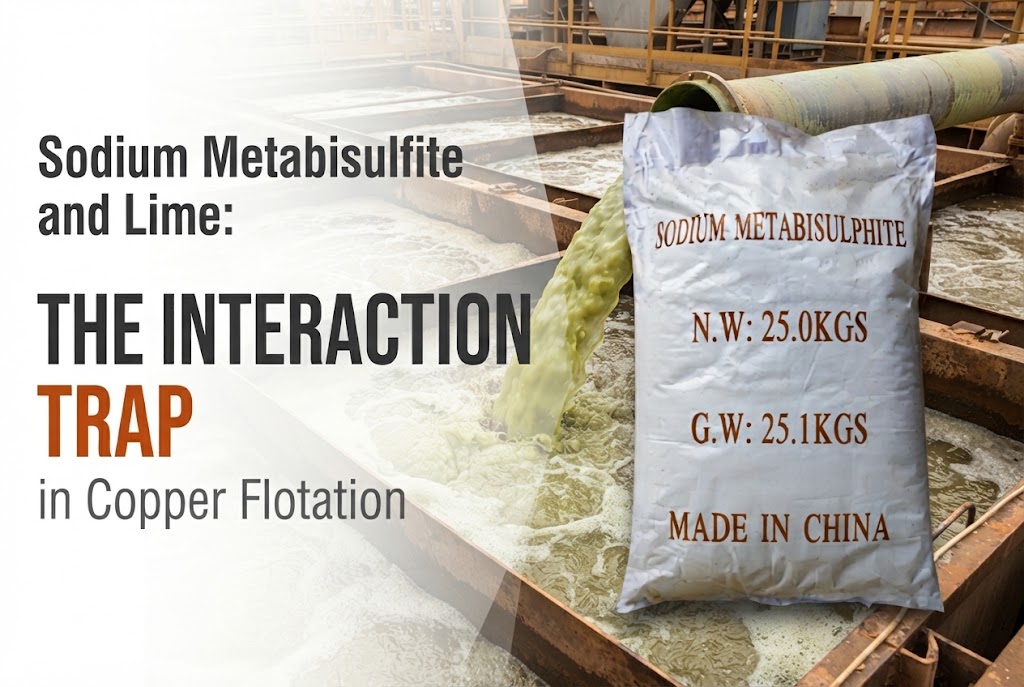
In copper flotation, sodium metabisulfite in copper flotation is widely considered a useful reagent for pyrite depression, while lime is commonly used to control pH and selectively depress pyrite. Individually, both reagents can have a clear process role. The problem begins when their interaction is overlooked.
Research on chalcopyrite flotation has shown that sodium metabisulfite (SMBS) and slaked lime can interact to form calcium sulfite (CaSO₃) on the chalcopyrite surface. Under specific laboratory conditions, this interaction significantly reduced chalcopyrite recovery even when potassium amyl xanthate (PAX) was present. In one reported test at pH 9, chalcopyrite recovery decreased from 97% to 66%.
This finding does not mean that SMBS and lime should never be used together. Instead, it highlights a more important process-control issue:
Reagent performance cannot always be evaluated independently when multiple chemicals are present in the flotation circuit.
For plants targeting high copper recovery, understanding the interaction between SMBS, lime, calcium ions, PAX, and chalcopyrite can help explain unexpected recovery losses and guide more targeted reagent optimization.
Why Are SMBS and Lime Commonly Used in Copper Flotation?
Before examining the interaction, it is useful to understand why both reagents are used.
The Role of Sodium Metabisulfite
Sodium metabisulfite, with the chemical formula Na₂S₂O₅, is commonly used as a sulfite-based depressant in mineral flotation.
In copper flotation circuits, SMBS can be used to help depress pyrite, particularly in complex ores and saline-water systems where selective separation can become more challenging. Research has investigated SMBS as a pyrite depressant in chalcopyrite flotation using saline water.
However, its effect is not necessarily limited to pyrite.
Depending on water chemistry, pH, collector conditions, dosage, and mineral surface state, SMBS can also influence chalcopyrite surface chemistry and floatability. A 2022 study found that SMBS treatment produced sulfate and other hydrophilic species on chalcopyrite and could reduce collector adsorption under certain conditions.
The Role of Lime
Lime, including calcium oxide (CaO) and slaked lime [Ca(OH)₂], is widely used to raise and control pH in sulfide mineral flotation.
In copper flotation, alkaline conditions can help suppress pyrite while allowing chalcopyrite to be recovered with an appropriate collector system.
However, lime does more than change pH.
It also introduces calcium species into the flotation environment.
That distinction becomes important when sulfite-containing reagents such as SMBS are present.
The Hidden Variable: Calcium Ions in the Flotation Water
When lime or slaked lime is added to process water, calcium becomes part of the chemical environment.
Calcium can also already be present in saline or seawater-based flotation systems. The 2022 chalcopyrite study specifically noted that seawater contains calcium ions and investigated how these calcium species interact with SMBS.
This means that a flotation operator evaluating SMBS dosage should not consider only:
SMBS concentration → pyrite depression
The actual system is closer to:
SMBS + Ca²⁺ + pH + collector + mineral surface + water chemistry
The interaction among these variables can determine whether the desired selectivity is maintained.
How Does Calcium Sulfite Form?
SMBS does not simply remain unchanged after entering the flotation pulp.
Under the relevant aqueous conditions, sulfite-related species can interact with calcium ions.
The reported research found that combining SMBS treatment with Ca(OH)₂ resulted in the formation of calcium sulfite (CaSO₃) on the chalcopyrite surface.
A simplified conceptual representation is:
SMBS → sulfite-related species
Ca(OH)₂ → Ca²⁺ / alkaline calcium environment
Ca²⁺ + sulfite species → CaSO₃ precipitation
The important process point is not simply the precipitation reaction itself.
It is where the precipitate forms.
When calcium sulfite deposits on the mineral surface, it can modify the surface properties that are required for collector adsorption and flotation.
Why Can CaSO₃ Reduce Chalcopyrite Recovery?
Flotation depends heavily on surface chemistry.
For chalcopyrite to float efficiently, collector molecules such as PAX need to interact with the mineral surface and generate sufficient hydrophobicity for attachment to air bubbles.
A hydrophilic surface layer can interfere with this process.
The 2022 study found that the SMBS–Ca(OH)₂ combination formed CaSO₃ on the chalcopyrite surface and that SMBS also reduced adsorbed PAX. The authors associated these surface changes with the reduction in chalcopyrite recovery.
The mechanism can therefore be understood conceptually as:
SMBS + calcium → CaSO₃ surface precipitation
↓
Surface becomes less favorable for collector interaction
↓
Reduced surface hydrophobicity
↓
Lower bubble attachment probability
↓
Lower chalcopyrite recovery
This is why the issue should be considered a reagent interaction problem, rather than simply an “excess SMBS” problem.
The 97% to 66% Recovery Result: What Does It Actually Mean?
One of the most useful findings from the published study is the change in chalcopyrite recovery from 97% to 66%.
However, this number needs to be interpreted correctly.
The result was obtained under specific experimental conditions involving:
- Chalcopyrite
- SMBS
- Slaked lime [Ca(OH)₂]
- PAX
- pH 9
- Laboratory flotation conditions
The researchers reported that the combined SMBS and Ca(OH)₂ treatment formed CaSO₃ on the chalcopyrite surface and significantly reduced recovery from 97% to 66% in the presence of PAX.
Therefore, 66% should not be treated as a universal industrial recovery value.
Instead, the result provides an important technical warning:
Under the tested conditions, the interaction between a pyrite depressant and a calcium-based pH modifier was sufficient to materially change chalcopyrite flotation behavior.
This is highly relevant when a plant observes copper recovery deterioration after changing reagent dosage or water chemistry.
Why Does PAX Not Completely Prevent the Problem?
PAX is commonly used as a collector for copper sulfide minerals.
A reasonable assumption might be that increasing collector dosage could compensate for the depressive effect of SMBS and lime.
The experimental results suggest that this assumption is not always sufficient.
The study found that PAX significantly reduced the depressing effect of SMBS or Ca(OH)₂ individually. However, when SMBS and Ca(OH)₂ were combined, CaSO₃ formation still significantly reduced chalcopyrite recovery.
This creates an important distinction:
Individual Reagent Effect
SMBS → depression
Lime → depression under certain conditions
Combined Reagent Effect
SMBS + Ca(OH)₂ → CaSO₃ formation → additional surface modification
Therefore, simply increasing PAX may not be the most effective response if the underlying issue is a mineral-surface precipitate.
The more appropriate question becomes:
Can the reagent sequence, dosage, pH, or calcium environment be adjusted to reduce the unwanted interaction?
Why Reagent Sequence Can Matter
Flotation reagents do not operate in isolation.
The order and timing of reagent addition can influence:
- Mineral surface condition
- Reagent adsorption
- Precipitation reactions
- Local reagent concentration
- Conditioning time
- Collector availability
For this reason, a plant troubleshooting a recovery decline should record not only reagent dosage but also addition point and conditioning time.
For example, these two process routes may have the same nominal reagent consumption:
Route A: Lime → SMBS → PAX
Route B: SMBS → Lime → PAX
Yet they may not produce identical surface conditions.
The exact outcome must be established through plant or laboratory testing rather than assumed from reagent names alone.
What Should Operators Monitor When Copper Recovery Drops?
When a copper circuit experiences an unexpected recovery decline after introducing or increasing SMBS, several variables should be reviewed together.
1. SMBS Dosage
Check whether the actual SMBS concentration has changed relative to the established operating window.
Do not evaluate dosage only on a kg/t basis if process-water chemistry has also changed.
2. Lime Dosage and pH
Track both lime consumption and actual flotation pH.
A change in lime addition can change calcium availability as well as alkalinity.
3. Calcium Concentration
This becomes especially important in:
- Seawater flotation
- Recycled process water
- High-hardness water
- Circuits with substantial lime addition
Calcium is a potential participant in the SMBS–lime interaction, so water chemistry should be included in the investigation.
4. PAX Dosage and Conditioning
Collector dosage should be evaluated alongside SMBS and lime.
Changes in collector adsorption can provide useful evidence of altered mineral surface conditions.
5. Water Chemistry
A flotation circuit using recycled or saline water may have a substantially different ionic environment from a freshwater circuit.
The same reagent dosage can therefore produce different results under different water chemistry.
How Can Plants Reduce the SMBS–Lime Interaction Risk?
There is no universal dosage ratio that can be applied to every copper ore.
Ore mineralogy, water chemistry, pH, collector system, residence time, and reagent addition sequence all matter.
However, several process-development approaches can be evaluated.
Approach 1: Optimize the SMBS-to-Lime Ratio
When high copper recovery is the priority, avoid treating SMBS and lime as completely independent dosage variables.
Instead, test them as a combined reagent system.
A laboratory matrix could evaluate:
| Test Variable | Example Test Direction |
|---|---|
| SMBS | Low → medium → high |
| Lime | Low → medium → high |
| pH | Several controlled levels |
| PAX | Fixed baseline + optimized level |
| Water | Freshwater vs process water |
| Conditioning | Different addition sequences |
| Recovery | Cu recovery + pyrite recovery |
The objective is to identify the operating window that balances:
Pyrite depression + copper recovery
rather than maximizing either variable independently.
Approach 2: Evaluate Lower-Alkalinity Operation
If the metallurgical objective allows it, a lower-pH operating window may reduce the need for large lime additions.
Research on saline-water copper flotation has investigated SMBS as a pyrite depressant under lower-alkaline conditions, including work reporting pyrite depression around pH 8.5. Other research has also found that SMBS can affect chalcopyrite flotation, so the effect on both minerals must be tested for the specific ore.
This means that lowering lime consumption can be worth investigating, but it should not be assumed to improve selectivity automatically.
Approach 3: Test Reagent Addition Sequence
Rather than changing total dosage immediately, compare different addition sequences under controlled laboratory conditions.
For example:
- Lime → SMBS → collector
- SMBS → lime → collector
- Lime → collector → SMBS
- Split addition of SMBS
- Split addition of lime
The objective is to determine whether changing the local chemical environment can reduce unwanted surface precipitation while maintaining pyrite depression.
Approach 4: Separate the Functions of pH Control and Pyrite Depression
If SMBS is being used primarily for pyrite depression and lime is being used primarily for pH control, it may be useful to evaluate whether both functions can be achieved with less interaction.
This does not necessarily mean eliminating either reagent.
Instead, the process question becomes:
What is the minimum lime requirement for the target pH, and what is the minimum SMBS dosage required for the desired pyrite depression?
Reducing unnecessary reagent excess can help narrow the interaction window.
A Practical Troubleshooting Workflow
When a plant observes a sudden decline in copper recovery, the following workflow can help isolate the cause.
Step 1: Confirm the Recovery Change
Compare current copper recovery with a stable historical baseline.
Check whether the change occurs in:
- Rougher recovery
- Cleaner recovery
- Overall recovery
- Concentrate grade
Step 2: Check Reagent Changes
Review:
- SMBS dosage
- Lime dosage
- PAX dosage
- Addition points
- Conditioning times
Step 3: Check Water Chemistry
Compare:
- Calcium
- Sulfate/sulfite-related species where analytically practical
- pH
- Ionic strength
- Recycled-water ratio
Step 4: Run Controlled Bench Tests
Keep ore preparation and collector conditions controlled while varying SMBS and lime.
This can help determine whether the recovery loss is associated with their interaction.
Step 5: Compare Recovery and Selectivity
Do not optimize copper recovery alone.
A useful test should evaluate at least:
Copper recovery + copper grade + pyrite recovery
An operating condition that increases copper recovery but also dramatically increases pyrite recovery may not provide the desired concentrate quality.
Why This Matters More in Saline and Recycled Water
The SMBS–lime interaction deserves particular attention when flotation uses seawater, saline water, or recycled process water.
These water sources can contain dissolved ions that change the chemical environment of the pulp.
The 2022 study specifically examined SMBS and Ca(OH)₂ in the context of calcium-containing water and noted the relevance of calcium in seawater.
Therefore, a reagent scheme developed using one water source should not automatically be transferred to another without validation.
A practical rule is:
Change the water chemistry → revalidate the reagent scheme.
This is especially important when moving from freshwater to seawater or increasing recycled-water utilization.
The Key Lesson: Optimize Reagent Interactions, Not Individual Reagents
The central lesson from the SMBS–lime interaction is that flotation chemistry is a system.
A reagent that works effectively in isolation can behave differently when another reagent changes the surface or solution chemistry.
For sodium metabisulfite in copper flotation, the key variables include:
- SMBS concentration
- Calcium concentration
- Lime dosage
- pH
- PAX concentration
- Water chemistry
- Conditioning time
- Addition sequence
- Chalcopyrite surface condition
The reported CaSO₃ formation provides a mechanistic explanation for why simply increasing collector dosage may not fully recover the lost floatability under some conditions.
Final Knowledge Summary
The apparent “synergy” between lime and sodium metabisulfite can become a process-control trap when the combined chemistry begins to affect chalcopyrite rather than only depressing pyrite.
The most important points are:
- SMBS is widely studied as a pyrite depressant in copper flotation, particularly in saline-water systems.
- Lime provides both pH control and calcium species that can influence flotation chemistry.
- SMBS and Ca(OH)₂ can form CaSO₃ on the chalcopyrite surface under the conditions reported in the literature.
- The reported laboratory test showed chalcopyrite recovery decreasing from 97% to 66% at pH 9 with PAX when SMBS and Ca(OH)₂ were combined.
- This result is condition-specific and should not be treated as a universal industrial recovery loss.
- For plants targeting high copper recovery, SMBS and lime should be evaluated as an interacting reagent system rather than optimized independently.
Ultimately, the most useful process adjustment may not be simply “more SMBS” or “more PAX.” It may be a more controlled balance of SMBS dosage, lime dosage, pH, calcium concentration, reagent sequence, and conditioning time based on the actual ore and process water.
For B2B reagent buyers and flotation engineers, this interaction also highlights why sodium metabisulfite selection should be accompanied by application-specific laboratory validation before large-scale process changes are made.