


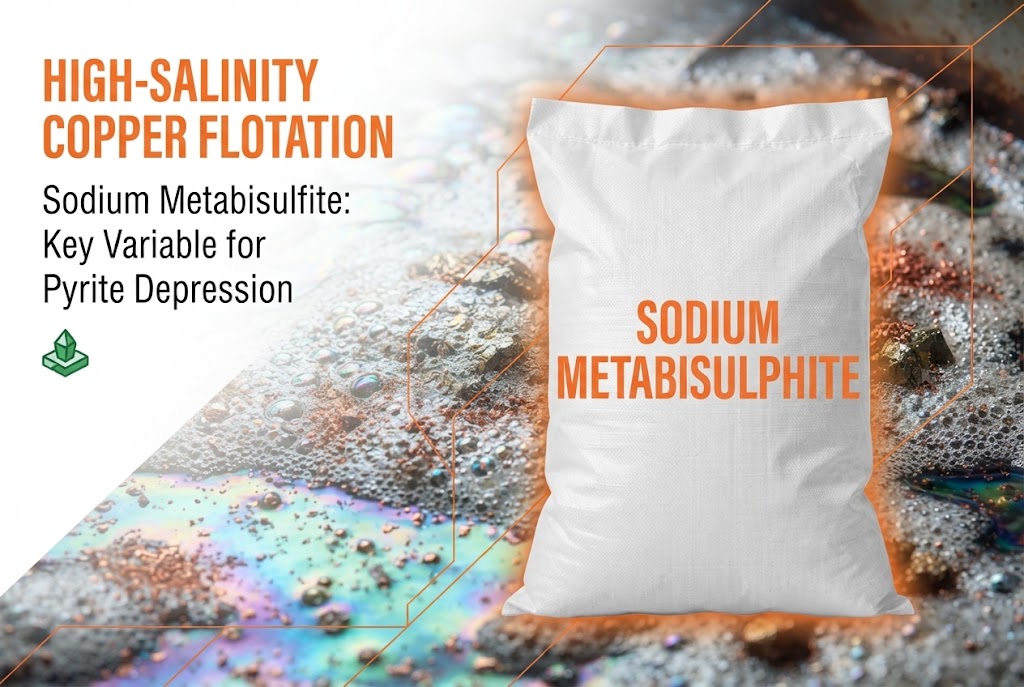
Sodium Metabisulfite for Pyrite Depression in High-Salinity Copper Flotation
High-salinity process water creates a major selectivity challenge in modern copper flotation. As mines increasingly use seawater, recycled water, or saline process streams, dissolved ions can promote unwanted copper activation of pyrite (FeS₂).
This activation allows pyrite to float with valuable copper minerals. The result can include lower copper concentrate grade, higher sulfur content, and increased smelter penalties.
Reverse osmosis can reduce the impact of saline water, but desalination requires significant CAPEX, energy, and operating costs. As an alternative, sodium metabisulfite (Na₂S₂O₅, MBS) can be used as a chemical pyrite depressant when its dosage and pulp chemistry are properly controlled.
1. Why High-Salinity Water Activates Pyrite in Copper Flotation
High-salinity flotation circuits contain elevated concentrations of dissolved ions and increased ionic strength. These conditions can influence mineral dissolution, surface reactions, collector behavior, and bubble interactions.
One important concern is the transfer of dissolved Cu²⁺ ions onto pyrite surfaces.
The simplified process can be represented as:
Saline Process Water
        │
        ▼
Dissolution of Cu²⁺ Ions
        │
        ▼
Copper Activation of Pyrite (FeS₂)
        │
        ▼
Formation of CuS-Like Surface Species
        │
        ▼
Increased Pyrite Hydrophobicity
        │
        ▼
Unwanted Pyrite Recovery
        │
        ▼
Lower Copper Concentrate Selectivity
Once copper-bearing surface species form on pyrite, the mineral can respond more strongly to collectors. This makes selective pyrite depression more difficult than in conventional freshwater circuits.
2. How Sodium Metabisulfite Depresses Pyrite
The effectiveness of sodium metabisulfite for pyrite depression depends on its interaction with the mineral surface and the surrounding pulp chemistry.
When MBS dissolves in water, it produces sulfite and bisulfite species:
Na2S2O5+H2O⇌2NaHSO3Na_2S_2O_5 + H_2O \rightleftharpoons 2NaHSO_3
These species participate in the redox and surface-conditioning reactions that influence pyrite flotation.
2.1 Removal of Copper Activation Species
Bisulfite and sulfite species act as reducing agents in the flotation pulp. They can help remove or modify copper-containing species from activated pyrite surfaces.
Removing this collector-responsive surface layer reduces the artificially increased hydrophobicity of pyrite.
As a result, pyrite becomes less responsive to collectors such as xanthates.
2.2 Formation of Hydrophilic Iron Surface Species
MBS can also modify pulp potential and surface oxidation conditions.
Under suitable conditions, iron hydroxide and iron oxide species can form on the pyrite surface. These hydrophilic species interfere with collector adsorption and reduce pyrite floatability.
Therefore, MBS pyrite depression involves more than simply changing the bulk solution. The reagent also changes the chemical condition of the mineral-water interface.
2.3 Pulp Potential and pH Control
Effective MBS performance depends strongly on pulp potential (Eₕ) and pH.
The original operating range identifies pH 7.0–9.0 as a suitable range for MBS-based pyrite depression. This provides an alternative to traditional lime-based depression at highly alkaline conditions.
For comparison, conventional lime depression may require a pH of approximately 10.5 or higher.
Maintaining a suitable pH and Eₕ window is therefore essential for balancing pyrite rejection with copper recovery.
3. High-Chromium Grinding Media and MBS Performance
Grinding media can significantly influence flotation chemistry.
Forged carbon steel can generate iron-containing debris and promote galvanic interactions during grinding. These reactions can change dissolved oxygen conditions and influence mineral surface chemistry.
High-chromium grinding media can reduce these effects and provide a more controlled chemical environment for MBS-based pyrite depression.
The overall process can be simplified as follows:
Saline Process Water
        │
        ▼
Cu²⁺ Activation of Pyrite
        │
        ▼
MBS Addition + High-Chromium Grinding Media
        │
        ▼
Controlled Pulp Eh
        │
        ▼
Modification / Removal of Cu-Activated Surface Species
        │
        ▼
Hydrophilic Iron Surface Layer
        │
        ▼
Reduced Collector Adsorption
        │
        ▼
Pyrite Depression
This combination can be particularly relevant when plants operate with saline or recycled process water.
4. Sodium Metabisulfite vs. Reverse Osmosis for Saline Flotation Water
Mining operations can address saline-water problems through either water treatment or reagent-based flotation control.
| Processing Parameter | Reverse Osmosis Desalination | Sodium Metabisulfite Chemical Route |
|---|---|---|
| Capital and Infrastructure | High; requires desalination and membrane systems | Lower; uses chemical dosing and storage equipment |
| Operating Energy | High due to pressure-driven filtration | Lower; based mainly on reagent preparation and dosing |
| Pyrite Rejection | High by removing saline-water effects | High when dosage and pulp chemistry are optimized |
| Copper Recovery Impact | No direct recovery penalty from the depressant | Controlled loss may occur, approximately 1–3% |
| Remote-Mine Feasibility | Can be economically difficult | More suitable for an OPEX-driven approach |
The two approaches address the problem differently. Reverse osmosis changes the water chemistry before flotation, while MBS controls mineral surface chemistry inside the flotation circuit.
5. MBS Dosage: Balancing Pyrite Depression and Copper Recovery
The main technical challenge when applying sodium metabisulfite in copper flotation is dosage control.
MBS must provide sufficient reducing conditions to depress copper-activated pyrite without excessively affecting valuable copper minerals such as chalcopyrite and bornite.
Under-Dosing
Insufficient MBS leaves copper activation sites on pyrite surfaces.
Pyrite can therefore remain responsive to collectors and report to the copper concentrate. This increases sulfur contamination and reduces concentrate selectivity.
Over-Dosing
Excessive MBS can reduce pulp potential beyond the desired operating window.
Under these conditions, the surface chemistry of valuable copper minerals may also be affected. Partial oxidation or excessive depression of chalcopyrite can reduce overall copper recovery.
Optimal Dosage
The target is a controlled dosage window that maximizes pyrite depression while keeping copper recovery within the plant’s acceptable operating range.
A simplified relationship is:
Pyrite Depression
      ▲
      │                  ┌──────── Optimal Region
      │                / │
      │              /   │
      │            /     │
      │___________/       └──────────────
      └──────────────────────────────────►
          Low       Optimal       Excessive
                    MBS Dosage

Copper Recovery
      ▲
      │───────────────────\
      │                    \
      │                     \
      │                      \  Excessive Depression
      └──────────────────────────────────►
          Low       Optimal       Excessive
                    MBS Dosage
For industrial flotation circuits, dosage optimization should therefore consider pyrite recovery, copper recovery, concentrate sulfur, pulp Eₕ, pH, and reagent distribution together.
6. How to Optimize MBS Addition in High-Salinity Copper Flotation
6.1 Use Stage Addition Instead of a Single Dosing Point
Applying the full MBS dosage at one location can create excessive local reducing conditions.
A staged dosing strategy distributes the reagent across suitable flotation stages. MBS can be introduced during grinding or conditioning for surface conditioning and then adjusted in cleaner stages.
This approach allows operators to maintain more controlled Eₕ conditions while reducing the risk of excessive copper-mineral depression.
6.2 Monitor Pulp Eh and pH
MBS performance cannot be evaluated by dosage alone.
Operators should monitor:
- MBS dosage
- Pulp pH
- Pulp Eₕ
- Copper recovery
- Pyrite recovery
- Concentrate sulfur content
- Copper concentrate grade
These variables help establish the operating window for selective pyrite depression.
6.3 Consider Grinding Media Chemistry
Grinding media should be included in the reagent optimization strategy.
Where carbon-steel grinding generates excessive galvanic effects, high-chromium media may provide a more stable chemical environment for MBS-based pyrite depression.
7. Frequently Asked Questions About MBS for Pyrite Depression
Why is pyrite depression more difficult in seawater?
Seawater contains elevated concentrations of chloride, sulfate, and other dissolved ions. Higher ionic strength can modify mineral dissolution, surface reactions, collector behavior, and bubble interactions.
These changes can promote copper activation of pyrite and make selective depression more difficult.
How can operators reduce copper recovery losses when using MBS?
Operators can use stage-addition dosing instead of adding the entire reagent requirement at one point.
MBS can be introduced during grinding or conditioning and adjusted in cleaner stages. This approach provides greater control over surface conditioning and pulp Eₕ.
What pH range is suitable for MBS pyrite depression?
The operating range presented here is approximately pH 7.0–9.0.
This is lower than the highly alkaline conditions commonly associated with lime-based pyrite depression, where pH may reach 10.5 or higher.
Can MBS eliminate pyrite recovery?
The performance of MBS depends on mineralogy, water chemistry, reagent dosage, grinding conditions, pulp Eₕ, pH, and flotation-stage configuration.
Therefore, the practical objective is to establish an optimized operating window rather than assume a fixed depression result for every ore type.