



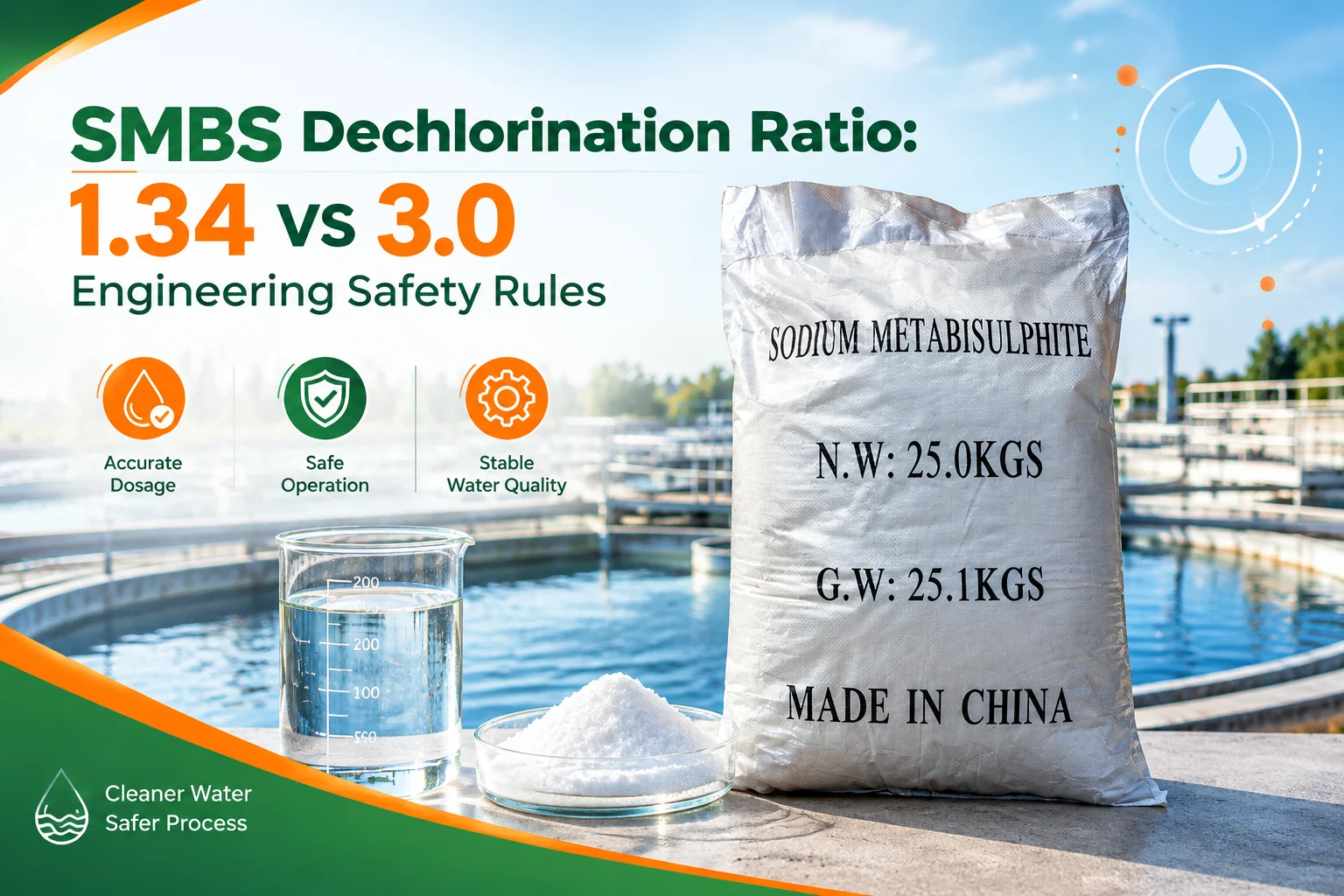
In reverse osmosis (RO) pre-treatment systems, free chlorine such as hypochlorous acid must be neutralized before it reaches polyamide membranes. Otherwise, residual chlorine can cause severe membrane degradation and premature failure.
On paper, the theoretical calculation requires 1.34 mg of pure sodium metabisulfite (Na₂S₂O₅) to neutralize 1.0 mg of free active chlorine.
However, water treatment operators who dose strictly at the 1.34:1 stoichiometric ratio may still observe residual chlorine breakthrough in actual plant operation.
As a result, the practical sodium metabisulfite dosage for dechlorination typically ranges from 2.0 to 3.0 mg per 1.0 mg of free chlorine.
The difference comes from real-world water chemistry, dissolved oxygen, chemical condition, hydraulic mixing, and reaction residence time.
Theoretical vs. Practical Sodium Metabisulfite Dosage
The 1.34:1 ratio provides a theoretical chemical baseline. It assumes ideal reaction conditions and complete utilization of the reducing agent.
Actual RO pre-treatment systems operate under less controlled conditions.
| Parameter / Variable | Ideal Theoretical Baseline | Field Engineering Practice |
|---|---|---|
| SMBS Stoichiometric Ratio | 1.34 mg SMBS / 1.0 mg Cl₂ | 2.0–3.0 mg SMBS / 1.0 mg Cl₂ |
| Safety Coefficient (S_f) | 1.0 | 1.5–2.2× theoretical requirement |
| Dissolved Oxygen (DO) | Ignored | Consumes active bisulfite through background oxidation |
| Mixing Dynamics | Instantaneous molecular mixing | Depends on pipe turbulence and injection quality |
| Reaction Residence Time | Complete equilibrium | Limited by pipe velocity; optimal ≥20–30 s |
Therefore, engineers should treat 1.34 mg/mg as the theoretical floor rather than the final operating dosage.
Why Does Practical SMBS Consumption Exceed the 1.34:1 Ratio?
Three major factors explain the difference between theoretical consumption and actual plant requirements:
- Dissolved oxygen consumes part of the active bisulfite.
- Poor mixing or insufficient residence time can allow chlorine to bypass the reaction.
- Chemical purity, storage oxidation, and temperature can reduce effective reaction performance.
1. Dissolved Oxygen Creates Additional SMBS Demand
When sodium metabisulfite dissolves in water, it forms sodium bisulfite:
Na₂S₂O₅ + H₂O → 2NaHSO₃
The resulting bisulfite ions can react with dissolved oxygen as well as chlorine.
The relevant oxidation reaction is:
2HSO3−+O2⟶2SO42−+2H+2HSO_3^- + O_2 \longrightarrow 2SO_4^{2-} + 2H^+
This means dissolved oxygen can consume active bisulfite before the reducing agent reaches the free chlorine.
The effect becomes more significant in:
- Well-aerated surface water
- Open intake systems
- Open chemical storage or preparation tanks
- Feed water with higher dissolved oxygen
Therefore, systems with higher DO may require a larger SMBS safety factor.
2. Mixing Efficiency and Residence Time Affect Dechlorination
Chemical dosage alone does not guarantee complete chlorine removal.
The bisulfite ions must physically contact hypochlorous acid and other free chlorine species before the water reaches the RO membrane.
Poor hydraulic mixing can create concentration gradients inside the pipe.
For example, high-velocity pipe flow without adequate turbulent mixing can create poorly mixed streams. Chlorine can then pass through the dosing zone before the reaction reaches completion.
Engineering Measures
Two parameters are particularly important:
Static mixing
Installing static mixers in the chemical dosing line improves contact between the SMBS solution and process water.
Reaction residence time
Maintaining a minimum contact time of 20–30 seconds before the RO high-pressure pump inlet allows the oxidation-reduction reaction to proceed more completely.
Therefore, hydraulic design should be evaluated together with the chemical dosing rate.
3. Chemical Purity, Storage, and Temperature Change Effective Dosage
The theoretical 1.34:1 ratio assumes pure and fully active sodium metabisulfite.
Commercial-grade SMBS typically has a stated purity range of 97%–99%.
However, chemical activity can also decline during storage.
When SMBS solution remains exposed to air, it can gradually oxidize into inactive sodium sulfate:
Na₂SO₄
This reduces the amount of active reducing agent available for dechlorination.
Temperature also affects reaction kinetics.
Cold water can slow the reaction rate, so the system may require additional chemical input to achieve complete chlorine removal.
For this reason, engineers should consider both chemical condition and water temperature when establishing operating dosage.
How to Calculate Sodium Metabisulfite Dosage for Dechlorination
Instead of applying a fixed 1.34:1 ratio to every system, engineers can use an adjustable safety-factor model:
DSMBS=CCl2×1.34×SfD_{SMBS} = C_{Cl_2} \times 1.34 \times S_f
Where:
- D₍SMBS₎ = Required sodium metabisulfite dosage
- C₍Cl₂₎ = Measured peak free chlorine concentration in mg/L
- 1.34 = Theoretical stoichiometric coefficient
- S_f = Empirical safety factor based on raw water and system conditions
The safety factor accounts for chemical consumption and operational losses that the theoretical calculation does not include.
Recommended Safety Factors for Different Water Conditions
The original engineering framework provides three practical safety-factor scenarios.
| Water Treatment Condition | Typical Conditions | Suggested Safety Factor |
|---|---|---|
| Low-DO groundwater | DO ≤2.0 mg/L + inline static mixing | S_f = 1.5 |
| Surface water | DO ≈6.0–8.0 mg/L + residence time ≥20 s | S_f = 1.8 |
| Open intake seawater | Fluctuating chlorine loads or no static mixer | S_f = 2.2 |
For example, if the measured peak free chlorine concentration is known, the engineer can substitute the measured value into the formula and select the safety factor that matches the operating environment.
This approach provides a more adaptable basis for determining the sodium metabisulfite dosage for dechlorination.
Why the 2.0–3.0 mg/mg Practical Range Matters
The practical dosage range of 2.0–3.0 mg SMBS per 1.0 mg free chlorine reflects the gap between laboratory stoichiometry and industrial operating conditions.
The higher dosage does not mean that the basic chemical equation is incorrect.
Instead, it accounts for factors that the ideal calculation excludes:
- Dissolved oxygen consumption
- Incomplete chemical mixing
- Limited reaction residence time
- SMBS purity
- Oxidation during storage
- Lower reaction rates at cold temperatures
- Fluctuating chlorine loads
Therefore, engineers should use the theoretical ratio as a starting point and adjust the actual dosage according to measured water conditions.
Practical RO Pre-Treatment Dosing Checklist
Before finalizing an SMBS dosing strategy, water treatment engineers and procurement teams should evaluate several operating variables.
| Evaluation Item | Recommended Check |
|---|---|
| Free Chlorine | Measure peak Cl₂ concentration |
| Dissolved Oxygen | Determine whether DO increases chemical consumption |
| SMBS Purity | Confirm stated 97%–99% commercial purity range |
| Solution Condition | Check storage time and air exposure |
| Mixing | Verify static mixer or equivalent mixing performance |
| Residence Time | Target 20–30 seconds before the RO high-pressure pump |
| Water Temperature | Consider slower kinetics in cold water |
| Chlorine Load | Account for fluctuations rather than using only average values |
| Safety Factor | Select approximately 1.5–2.2 according to system conditions |
| Residual Chlorine | Verify actual breakthrough at the RO inlet |
This final verification is important because the objective is not simply to calculate a theoretical chemical dose.
The objective is to ensure that free chlorine does not reach the polyamide RO membrane.
Key Technical Takeaways
1. Stoichiometry Is a Minimum Baseline
The theoretical 1.34 mg SMBS / 1.0 mg Cl₂ ratio assumes ideal reaction conditions.
It should therefore be treated as a theoretical minimum rather than a universal operating dosage.
2. Field Dosage Is Usually Higher
Actual sodium metabisulfite dosage for dechlorination commonly falls within 2.0–3.0 mg SMBS per 1.0 mg free chlorine under the engineering conditions described above.
3. Dissolved Oxygen Consumes Active Bisulfite
DO competes with free chlorine for active bisulfite ions.
Well-aerated water therefore requires additional consideration when setting the safety factor.
4. Hydraulic Design Directly Affects Chemical Performance
Static mixing and 20–30 seconds of residence time can improve chemical contact and reduce chlorine bypass.
5. Use an Adjustable Safety Factor
The proposed engineering equation is:
DSMBS=CCl2×1.34×SfD_{SMBS} = C_{Cl_2} \times 1.34 \times S_f
with S_f = 1.5–2.2 depending on raw water and hydraulic conditions.
Final Engineering Principle
Reliable RO membrane protection requires more than calculating the theoretical sodium metabisulfite requirement.
Engineers should combine free chlorine concentration, dissolved oxygen, SMBS condition, mixing efficiency, residence time, water temperature, and chlorine load fluctuations when determining the actual dosage.
In practice, the 1.34:1 stoichiometric ratio provides the chemical baseline, while an appropriate safety factor bridges the gap between theoretical chemistry and real-world water treatment conditions.