


Sodium Metabisulfite Industrial Uses and Benefits
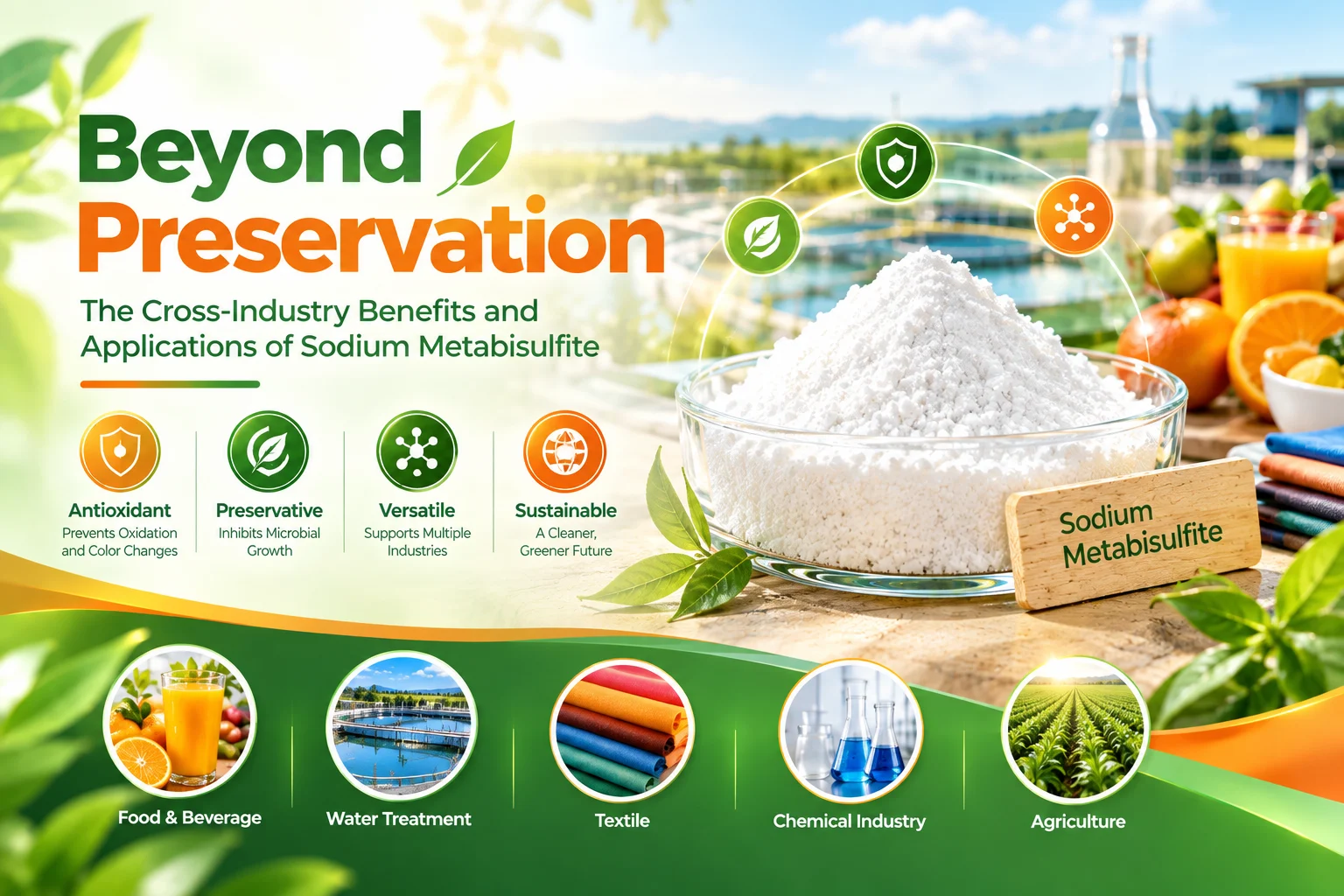
Sodium metabisulfite (SMBS) is a versatile inorganic chemical used across water treatment, petroleum operations, textile processing, and food manufacturing. Its reducing properties make it valuable for controlling oxidation, removing residual chlorine, and supporting specific chemical treatment processes.
For industrial procurement managers, understanding sodium metabisulfite industrial uses is essential for selecting the right product grade, evaluating technical suitability, and maintaining a reliable supply chain. Although different industries use SMBS for different purposes, they share a common requirement: consistent chemical quality that meets application-specific standards.
This guide examines the key applications of sodium metabisulfite, explains its underlying chemical mechanisms, and outlines the factors B2B buyers should consider when sourcing industrial quantities.
1. Sodium Metabisulfite Industrial Uses Across Four Key Industries
Sodium metabisulfite, with the chemical formula Na₂S₂O₅, is a white crystalline inorganic salt. When dissolved in water, it forms bisulfite-related species and can release sulfur dioxide under appropriate conditions. These chemical characteristics support its use as a reducing agent, oxygen scavenger, and dechlorinating agent.
The exact function depends on the process conditions, product grade, and required treatment outcome.
| Industry | Primary Application | Chemical Function | Potential Operational Benefit |
|---|---|---|---|
| Water treatment | Hexavalent chromium reduction | Converts Cr(VI) into Cr(III) under suitable conditions | Supports heavy-metal wastewater treatment |
| Petroleum and drilling | Oxygen scavenging and selected fluid formulations | Consumes dissolved oxygen or participates in specific chemical systems | Helps control oxygen-related corrosion risks |
| Textile and dyeing | Residual chlorine removal | Reduces chlorine-containing oxidants | Helps protect dyes and textile fibers |
| Food and beverage | Antioxidant and anti-browning agent | Limits oxidation in approved applications | Helps maintain product quality and appearance |
These applications demonstrate why sodium metabisulfite is relevant to multiple industrial supply chains. However, buyers should confirm that the selected grade, formulation, and operating conditions meet the requirements of their specific process.
2. Water Treatment: Reducing Hexavalent Chromium in Industrial Wastewater
Hexavalent chromium is a hazardous contaminant associated with electroplating, metal finishing, and other industrial processes. Sodium metabisulfite can serve as a reducing agent in wastewater treatment systems designed to convert Cr(VI) into trivalent chromium, Cr(III).
How Does Sodium Metabisulfite Reduce Chromium?
Under appropriately acidic conditions, dissolved sodium metabisulfite generates reducing species that convert hexavalent chromium into trivalent chromium.
The treatment process generally involves three stages:
- Reduction: Operators add sodium metabisulfite under controlled acidic conditions to convert Cr(VI) into Cr(III).
- Neutralization: Operators adjust the treated water’s pH to promote the formation of chromium hydroxide precipitates.
- Solid-liquid separation: Clarification or filtration removes the precipitated solids from the wastewater.
The appropriate operating pH depends on the wastewater composition, reduction kinetics, and treatment equipment. A pH range around 2.5–3.0 is used in some reduction systems, but operators should establish the actual setpoint through process validation.
How Much Sodium Metabisulfite Is Required?
Chemical dosage depends on the initial chromium concentration, wastewater composition, product purity, and treatment efficiency.
Under ideal stoichiometric conditions, reducing 1 mg of Cr(VI), expressed as elemental chromium, requires approximately 2.74 mg of pure sodium metabisulfite.
Actual consumption may be higher because of competing reactions, reagent purity, and process losses. Engineers should therefore use laboratory testing, such as jar tests, to establish an appropriate operating dosage rather than relying on a fixed ratio.
For industrial buyers, a consistent SMBS assay and reliable batch documentation can help improve dosing calculations and reduce process variability.
3. Petroleum and Drilling: Oxygen Scavenging and Fluid Formulation
Oxygen entering water-based drilling fluids can contribute to oxidative corrosion of steel equipment. Under suitable operating conditions, sodium metabisulfite can act as an oxygen scavenger by reacting with dissolved oxygen.
This application makes SMBS relevant to selected petroleum operations and industrial water-based fluid systems.
Key Functions in Drilling Operations
Oxygen control: Sodium metabisulfite can consume dissolved oxygen, helping reduce one potential contributor to corrosion. Actual protection depends on oxygen ingress, temperature, pH, residence time, and other chemicals in the system.
Fluid formulation: In selected formulations, sulfite-based chemistry may support the preparation or modification of chemical additives. Its suitability depends on the intended reaction and compatibility with the drilling-fluid system.
Process consistency: A well-controlled chemical dosing program helps operators maintain target conditions and monitor reagent consumption.
However, sodium metabisulfite does not automatically function as a universal drilling-mud thinner or corrosion inhibitor. Buyers should confirm its role in the specific formulation with the drilling-fluid engineer or additive manufacturer.
When sourcing SMBS for petroleum applications, evaluate product specifications, dissolution behavior, storage requirements, and compatibility with other treatment chemicals.
4. Textile and Dyeing: Removing Residual Chlorine
Textile bleaching and finishing processes may use chlorine-based oxidizing agents. If residual chlorine remains after bleaching, it can interfere with subsequent dyeing operations or damage sensitive fibers.
Sodium metabisulfite provides a reducing mechanism for neutralizing residual chlorine under appropriate process conditions.
Why Is Dechlorination Important?
Residual oxidants may cause unwanted color changes, uneven dyeing, or fiber degradation. Applying a suitable dechlorination treatment helps control these risks before the next production stage.
Typical process considerations include:
- Initial residual chlorine concentration.
- SMBS dosage and solution concentration.
- Water pH and temperature.
- Contact time and mixing efficiency.
- Compatibility with subsequent dyeing or finishing chemicals.
Operators should verify residual chlorine levels before proceeding to the next stage. Excessive chemical dosing can also affect downstream process conditions, so the treatment should follow a validated procedure.
For textile manufacturers, consistent chemical quality and predictable dissolution can help simplify production control across repeated batches.
5. Food and Beverage: Antioxidant and Anti-Browning Applications
Food-grade sodium metabisulfite is used in certain food processing applications as an antioxidant, anti-browning agent, or preservative where permitted by applicable regulations.
Its reducing properties help limit oxidation and enzymatic browning in suitable products. However, approved uses, maximum levels, labeling requirements, and restrictions vary by food category and destination market.
What Should Food Manufacturers Consider?
When purchasing sodium metabisulfite for food processing, buyers should verify:
- Compliance with the applicable food-grade specification.
- Assay and relevant impurity limits.
- Heavy-metal specifications and supporting documentation.
- Allergen-related and sulfite declaration requirements, where applicable.
- Permitted use levels and labeling requirements in the destination market.
Sodium metabisulfite is not suitable for every food application. Sulfites can cause adverse reactions in sensitive individuals, and manufacturers must comply with applicable food safety and labeling rules.
Important: Food-grade and industrial-grade SMBS should not be treated as interchangeable. Buyers must select a grade that meets the regulatory and technical requirements of the intended application.
6. How to Choose the Right Sodium Metabisulfite Supplier
For B2B buyers, purchasing sodium metabisulfite involves more than comparing unit prices. Product consistency, documentation, packaging, and delivery reliability all affect the total cost of procurement.
Evaluate Product Quality
Request a current technical data sheet and certificate of analysis. Depending on the application, relevant specifications may include:
- Sodium metabisulfite assay.
- Appearance and physical form.
- Iron and other relevant impurity limits.
- Moisture content.
- Applicable food-grade or industrial-grade compliance documentation.
The required specifications should match the buyer’s application rather than assume that one grade fits every industry.
Compare Supply and Logistics Capabilities
A reliable supplier should communicate clearly about production capacity, order lead times, packaging options, and shipment arrangements.
For recurring bulk orders, buyers should also assess whether the supplier can maintain agreed specifications across batches and provide traceable quality records.
Consider Total Procurement Cost
The lowest purchase price does not always deliver the best value. Differences in purity, dosage requirements, packaging, freight, and quality consistency can affect the overall cost of use.
A structured supplier evaluation should compare the delivered cost per usable unit of product, along with the risks associated with inconsistent quality or delayed shipments.
7. B2B Procurement FAQs
Q1: What are the main industrial uses of sodium metabisulfite?
The main applications include chromium reduction in wastewater treatment, oxygen scavenging in selected industrial and petroleum systems, residual chlorine removal in textile processing, and approved antioxidant applications in food manufacturing.
Q2: Is sodium metabisulfite an oxygen scavenger?
Yes. Sodium metabisulfite can react with dissolved oxygen under suitable conditions. Its effectiveness depends on temperature, pH, contact time, oxygen concentration, and the composition of the treatment system.
Q3: Can sodium metabisulfite remove hexavalent chromium from wastewater?
It can reduce Cr(VI) to Cr(III) under suitable conditions. The treatment process typically requires controlled pH adjustment followed by precipitation and solid-liquid separation. Operators must verify the final chromium concentration against applicable discharge requirements.
Q4: What is the difference between food-grade and industrial-grade sodium metabisulfite?
Food-grade products must meet the applicable food safety and purity requirements for their intended use. Industrial-grade products follow specifications designed for their industrial applications. Buyers should verify the relevant standards and documentation before selecting a grade.
Q5: How should sodium metabisulfite be stored?
Store the product in tightly closed, moisture-resistant packaging in a cool, dry, well-ventilated area. Protect it from moisture and incompatible materials, and follow the supplier’s safety data sheet for handling, storage, and personal protective equipment requirements.
Q6: What documents should buyers request from a sodium metabisulfite supplier?
Common documents include a technical data sheet, certificate of analysis, safety data sheet, and applicable regulatory or conformity documents. Food-processing buyers may require additional food-grade declarations and supporting compliance records.
Conclusion: Source Sodium Metabisulfite for Your Industrial Application
Sodium metabisulfite offers practical value across water treatment, petroleum operations, textile processing, and food manufacturing because of its versatile reducing chemistry.
However, successful application depends on selecting the appropriate product grade, controlling reaction conditions, and verifying performance against the requirements of the specific process.
For industrial procurement teams, a dependable supply partner should provide consistent product specifications, traceable quality documentation, suitable packaging, and clear communication about bulk orders.
Looking for a sodium metabisulfite supplier for your industrial or wholesale requirements? Contact our sales team to request a technical data sheet, review product specifications, and discuss bulk packaging, order quantities, and delivery options tailored to your application.