


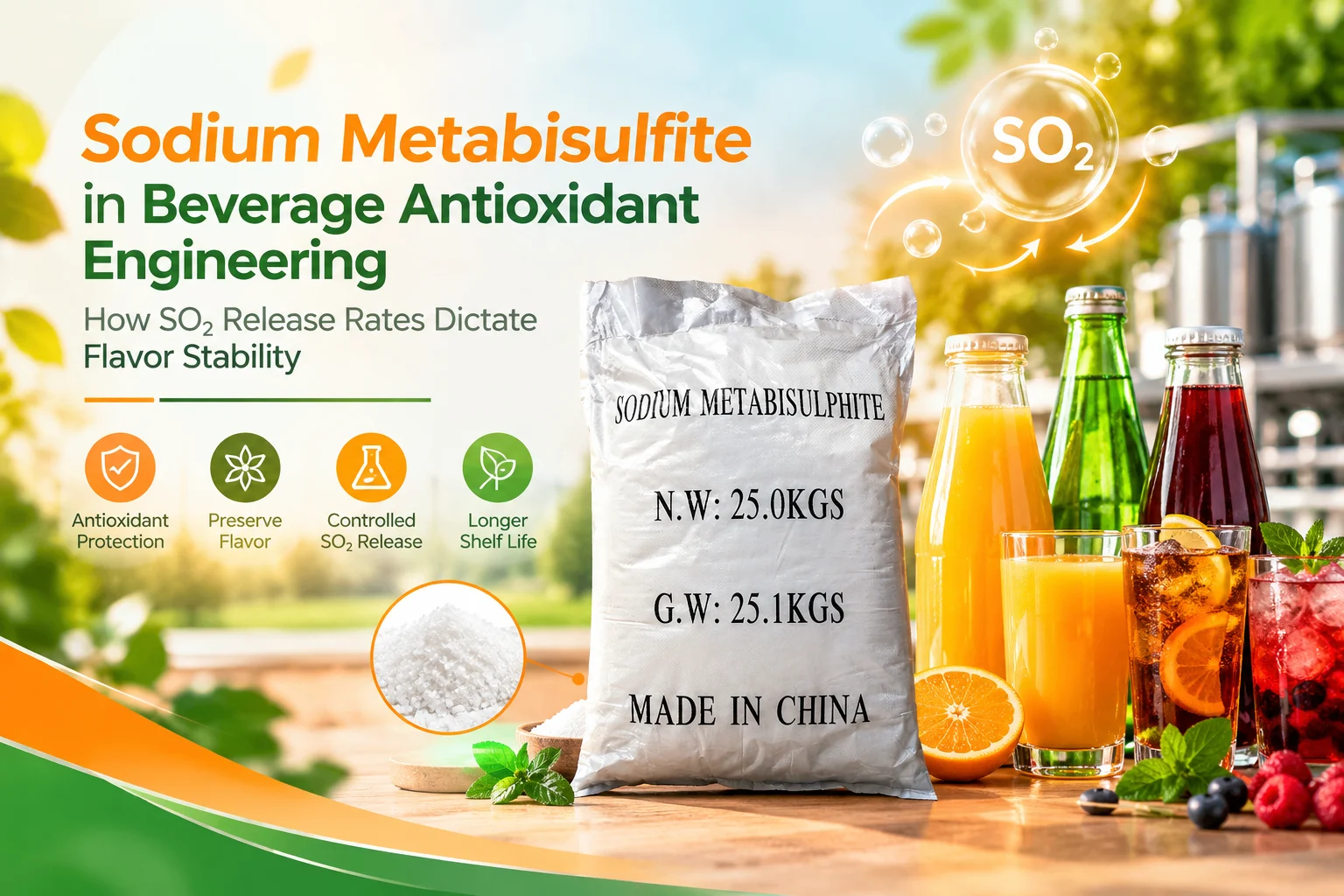
Controlling oxidation in commercial beverage manufacturing determines whether a product maintains its sensory profile or suffers from rapid quality degradation. Technical directors across wineries, juice processing plants, and ready-to-drink (RTD) tea facilities rely on sodium metabisulfite for beverages as a dual-action antioxidant and antimicrobial agent. When added to aqueous solutions, sodium metabisulfite (Na_2S_2O_5) hydrolyzes to release free sulfur dioxide (SO₂), which scavenges dissolved oxygen, neutralizes reactive oxidative species, and inhibits enzymatic browning. However, identical dosage rates often yield vastly different protection outcomes. The overall efficacy of sodium metabisulfite for beverage treatment depends heavily on the kinetic release rate of SO₂, which is governed by liquid pH, processing temperature, and initial dissolved oxygen concentrations.
1. Reaction Kinetics: The Science of SO_2 Release Rates
Understanding the chemical equilibrium of sulfur dioxide in liquid matrices explains why kinetic release controls long-term product stability:
-
pH Dependency: Lower pH levels shift equilibrium toward active molecular SO₂, the form responsible for antimicrobial action and immediate oxygen scavenging. In high-pH beverages, SO_2 converts into bisulfite ($\text{HSO}_3^-$) or sulfite ($\text{SO}_3^{2-}$) ions, altering oxidation kinetics.
-
Temperature Dynamics: Higher processing and storage temperatures accelerate the decomposition rate of metabisulfite, causing rapid initial SO₂ release. While this offers immediate protection against oxygen spikes during hot-filling, it shortens the residual protection window during shelf storage.
-
Dissolved Oxygen (DO) Concentration: If SO₂ release is too slow relative to high initial DO levels, rapid early-stage oxidation occurs before the chemical barrier establishes. Conversely, an excessively rapid release depletes free SO₂ prematurely, leaving the beverage vulnerable to late-stage oxidative staling.
2. Category-Specific Applications: Wine, Fruit Juice, and RTD Teas
The functional requirements of sodium metabisulfite for beverages vary based on matrix chemistry and target shelf-life goals:
1. Winemaking: Microbial Suppression & Polyphenol Protection
In enology, SO_2 acts as a selective antimicrobial and potent antioxidant. It suppresses wild yeast and spoilage bacteria (Acetobacter) while preserving delicate volatile aromatic esters. Free SO_2 also binds with acetaldehyde, preventing oxidative flat notes and maintaining color integrity in red and white wines.
2. Fruit Juices: Polyphenol Oxidase (PPO) Inhibition & Pigment Stabilization
Enzymatic browning caused by polyphenol oxidase (PPO) rapidly degrades freshly squeezed fruit juices. Sodium metabisulfite irreversibly inactivates the PPO enzyme system while preserving natural pigments such as anthocyanins and carotenoids, preventing unwanted color shifts during pasteurization and distribution.
3. Ready-to-Drink (RTD) Teas: Catechin Preservation & Clarity Control
Tea catechins and polyphenols are highly sensitive to thermal oxidation. Controlled SO₂ release prevents the oxidation of epigallocatechin gallate (EGCG), preventing tea brew darkening, astringent off-notes, and sediment haze formation in bottled green and black teas.
3. Recommended Dosage Reference Ranges
Below are typical industry dosage ranges for sodium metabisulfite for beverages across key manufacturing categories:
-
Wine & Cider Production: 50 to 150 ppm (Yields ~30–90 ppm total SO₂; adjusted according to must pH and fermentation stage)
-
Single-Strength Fruit Juices: 30 to 100 ppm (Protects against PPO enzymatic browning and color degradation)
-
Juice Concentrates: 100 to 300 ppm (Higher concentration required to prevent non-enzymatic Maillard browning during thermal concentration)
-
Ready-to-Drink (RTD) Teas: 20 to 60 ppm (Preserves delicate polyphenols and maintains liquid clarity)
Technical Summary
Optimizing flavor stability in beverage manufacturing requires matching the SO₂ release kinetics of sodium metabisulfite for beverages to your product’s specific pH, thermal history, and dissolved oxygen profile. Managing initial reaction rates prevents early oxidative damage while preserving a residual SO₂ buffer for extended shelf life. Incorporating high-purity sodium metabisulfite ensures consistent chemical performance, color preservation, and sensory integrity across commercial wine, juice, and tea formulations. SXS supplies food-grade sodium metabisulfite manufactured under strict quality standards for global beverage producers and B2B chemical distributors.