


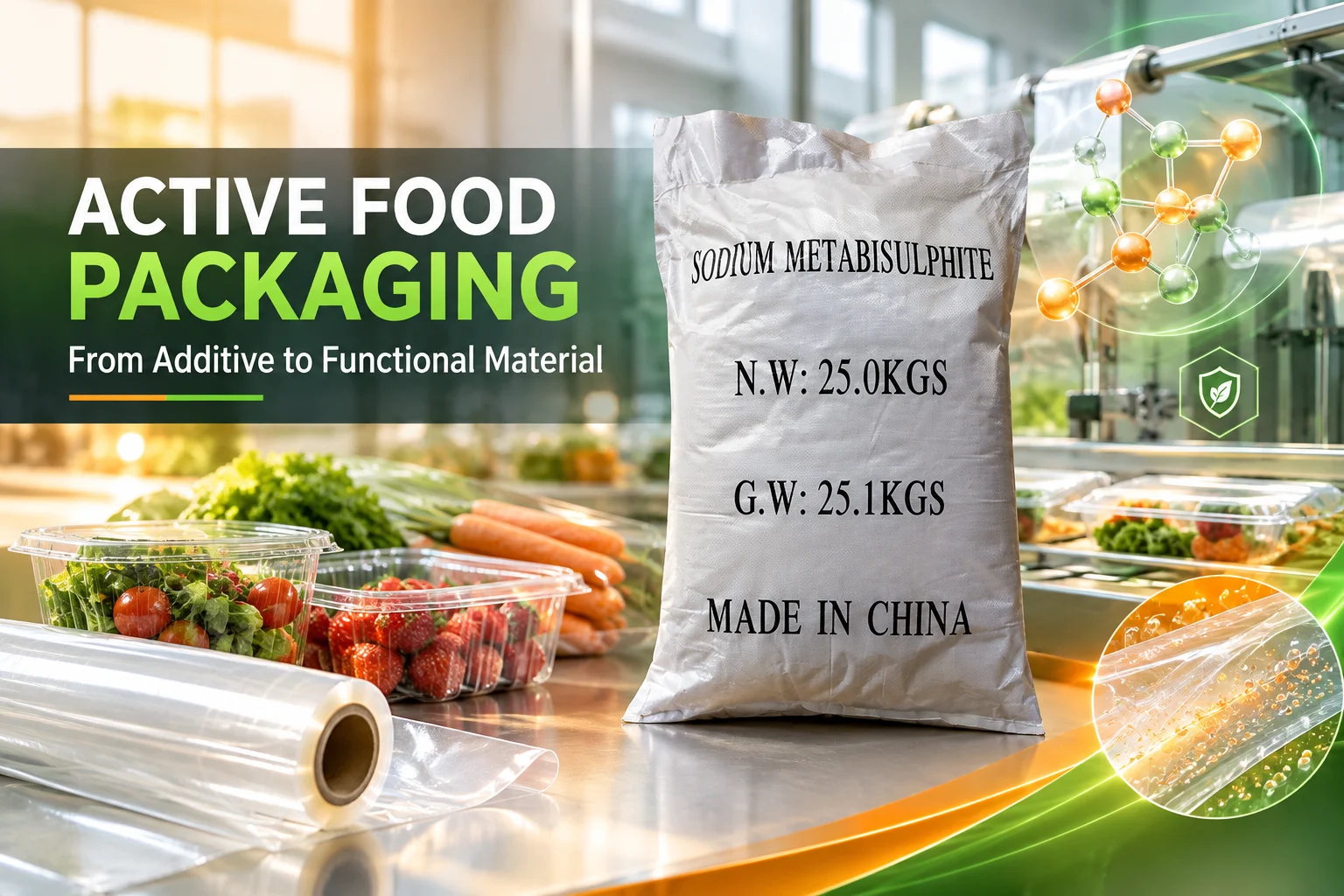
Sodium Metabisulfite in Active Food Packaging: From Food Additive to Functional Material
For decades, food processors and packaging procurement managers have used sodium metabisulfite (Na₂S₂O₅) as a traditional direct food additive.
It is widely recognized as a preservative, antioxidant, and anti-browning agent. Common applications include dried fruits, wines, and seafood processing.
However, the food packaging industry is evolving toward extended shelf life and cleaner-label solutions. This shift is creating new opportunities for sodium metabisulfite in active food packaging.
Instead of applying the chemical directly to food, packaging engineers can incorporate sodium metabisulfite into porous carrier materials. This approach allows it to function as a non-metallic oxygen scavenger inside the package.
The key question for food packaging manufacturers is simple:
How can sodium metabisulfite help prevent oxidation and enzymatic browning without direct contact with food?
The answer lies in controlled impregnation into porous carriers. This approach can create active packaging inserts, sachets, or film-based systems that remove oxygen from the package headspace.
1. The Evolution of Sodium Metabisulfite in Food Preservation
Traditional food preservation often involves applying sodium metabisulfite directly to the product.
This method remains important for established food processing applications. However, active packaging offers another way to control the package environment.
The evolution can be summarized as follows:
Traditional Direct Food Additive
- Sodium metabisulfite applied directly to food surfaces
- Used for preservation and anti-browning
- Common in dried fruits, wine, and seafood processing
Advanced Active Packaging Material
- Sodium metabisulfite impregnated into porous carriers
- Porous silica gel or porous polymers can serve as carrier materials
- Used in non-metallic oxygen scavenger sachets
- Can also be incorporated into active films or tray inserts
This approach moves sodium metabisulfite from direct food treatment toward functional packaging material applications.
2. Why Non-Metallic Oxygen Scavengers Matter
Traditional active food packaging often uses iron-based oxygen absorber sachets.
Iron-based systems can effectively reduce oxygen inside sealed packages. However, they create several challenges for modern automated food processing.
Metal Detector Interference
Iron-based oxygen absorber sachets can trigger automated metal detection systems.
This may create false alarms during high-speed packaging operations.
Microwave Packaging Limitations
Metal-based oxygen absorbers may create safety concerns in microwaveable food packaging.
Non-metallic oxygen scavenging chemistry provides an alternative for these applications.
Direct Contact Concerns
Traditional preservatives added directly to food require appropriate labeling and regulatory consideration.
Consumers are also increasingly interested in clean-label positioning.
Active packaging provides a way to separate the functional material from direct food treatment.
3. Sodium Metabisulfite as a Non-Metallic Oxygen Scavenger
One important development is the use of impregnated porous carriers.
South Korean packaging research teams have demonstrated that sodium metabisulfite can be impregnated onto porous media.
Porous silica gel is one example of a suitable carrier material.
The porous structure increases the available active surface area. This can improve interaction between the sodium metabisulfite and moisture inside the package.
According to the original research data, impregnated sodium metabisulfite achieved a 425% faster initial scavenging rate than unformulated raw sodium metabisulfite powder.
This increased reaction rate can be particularly valuable for fresh produce packaging.
Rapid Oxygen Reduction in Apple Packaging
When used inside active apple packaging, the system can reduce headspace oxygen concentration to below 0.5% within 3 days.
This rapid oxygen reduction can help control oxidation and surface enzymatic browning.
It also provides an alternative to direct chemical dipping treatments for certain fresh produce applications.
4. How Sodium Metabisulfite Scavenges Oxygen
The oxygen-scavenging mechanism occurs within the humid micro-environment of a sealed package.
Ambient moisture first activates the sodium metabisulfite.
Step 1: Hydration
Moisture hydrolyzes sodium metabisulfite to form sodium bisulfite:
Na2S2O5+H2O→2NaHSO3\text{Na}_2\text{S}_2\text{O}_5+\text{H}_2\text{O}\rightarrow2\text{NaHSO}_3
This hydration step makes the active sulfite species available for subsequent reactions.
Step 2: Oxygen Reaction
The bisulfite species then reacts with oxygen inside the package:
2NaHSO3+O2→2NaHSO42\text{NaHSO}_3+\text{O}_2\rightarrow2\text{NaHSO}_4
Through this process, oxygen is consumed within the package headspace.
Continuous oxygen reduction helps create a controlled atmosphere around the packaged product.
This can suppress aerobic bacterial growth and inhibit polyphenol oxidase (PPO) activity associated with enzymatic browning.
5. Direct Additives vs. Active Packaging vs. Iron Absorbers
Different preservation technologies offer different advantages.
For packaging engineers and procurement teams, the choice depends on food type, processing method, packaging structure, and production requirements.
| Performance Metric | Direct Additive Application | Iron-Based Oxygen Absorbers | Sodium Metabisulfite Active Packaging Inserts |
|---|---|---|---|
| Metal Detector Compatibility | Fully compatible | Incompatible; may trigger metal sensors | Fully compatible; non-metallic chemistry |
| Clean-Label Positioning | Requires chemical listing on food label | No direct food contact | Supports clean-label positioning through no direct food contact |
| Microwave Safety | Safe | Hazard due to potential sparking risk | Safe for microwaveable packaging |
| Enzymatic Browning Prevention | High through direct absorption | Moderate through oxygen reduction | Superior through oxygen scavenging and controlled sulfur dioxide vapor atmosphere |
| Production Line Integration | Spraying or dipping baths | Sachet insertion | Sachet, active film coating, or tray insert |
The main advantage of the active packaging approach is its ability to perform preservation functions inside the package environment.
This can reduce the need for direct application while maintaining controlled oxygen management.
6. Key Applications for Sodium Metabisulfite Active Packaging
As active packaging technology develops, sodium metabisulfite can support several high-value food preservation applications.
Fresh-Cut Fruits and Vegetables
Fresh-cut apples, pears, and potatoes can develop browning after cutting.
Active packaging can help reduce oxygen exposure around the product.
This provides an alternative approach to heavy direct-dipping treatments in selected applications.
Dried Fruits and Nuts
Dried fruits and nuts can experience oxidation during long-distance transportation.
Oxygen scavenging can help control oxidation, rancidity, and color darkening.
This is particularly relevant for products shipped through extended ocean freight cycles.
Processed Seafood and Crustaceans
Shrimp and lobster can develop black spot formation, also known as melanosis.
Active packaging can help control the package atmosphere and suppress oxidation-related quality deterioration.
Grain and Bakery Storage
Oxygen reduction can also support storage applications for grain and bakery products.
In high-moisture baked goods, reducing available oxygen can help inhibit mold growth.
The final packaging design should be matched to the product’s moisture level and storage conditions.
7. Why Porous Carrier Design Is Important
The performance of an active packaging system depends on more than the chemical itself.
Carrier structure plays an important role in controlling the available reaction surface.
Porous materials provide a larger surface area for sodium metabisulfite impregnation.
They can also help distribute the active material throughout the packaging component.
Potential carrier formats include:
- Porous silica gel
- Porous polymers
- Active sachets
- Active film coatings
- Tray inserts
This flexibility allows packaging engineers to select a format based on the package design and production process.
8. Product Highlight: SXS High-Purity Sodium Metabisulfite
SXS specializes in the bulk manufacture and global supply of high-purity sodium metabisulfite.
Its sodium metabisulfite products are designed for active packaging manufacturers, chemical distributors, and food processing enterprises.
Consistent Chemical Purity
SXS supplies industrial and food-grade sodium metabisulfite.
The products are engineered with controlled particle sizing and consistent bulk density.
These properties support predictable reactivity in active packaging formulations.
Strict Quality Control
SXS manufactures sodium metabisulfite under stringent ISO quality control systems.
The company supports international food-grade requirements for consistent chemical stability.
This provides B2B buyers with a more stable raw material source for continuous production.
Flexible Bulk Packaging
SXS supports multiple packaging formats for different procurement requirements.
Available options include:
- 25kg moisture-barrier bags
- 1000kg jumbo totes
- Bulk supply for industrial manufacturing
- Global shipping support
These options help packaging manufacturers align raw material supply with production volume.
9. Benefits for Active Packaging Manufacturers
For food packaging manufacturers, sodium metabisulfite offers several potential advantages.
Non-Metallic Chemistry
Unlike iron-based absorbers, sodium metabisulfite does not rely on metallic oxygen-scavenging chemistry.
This makes it attractive for applications where metal detection or microwave compatibility matters.
Controlled Oxygen Reduction
Impregnation into porous carriers can increase the available active surface area.
The original research data reports a 425% faster initial scavenging rate.
The same research reports oxygen reduction to below 0.5% within 3 days in active apple packaging.
Flexible Packaging Integration
The material can be incorporated into several packaging formats.
These include sachets, active film coatings, and tray inserts.
This gives packaging engineers greater flexibility when developing new active packaging structures.
10. Procurement Considerations for Sodium Metabisulfite
Choosing the right sodium metabisulfite supplier requires more than comparing bulk prices.
Packaging manufacturers should evaluate several factors before placing large-volume orders.
Chemical Grade
Determine whether the application requires industrial-grade or food-grade sodium metabisulfite.
Particle Size
Particle sizing can influence handling, formulation, and reaction behavior.
Consistent particle size is therefore important for repeatable production.
Bulk Density
Consistent bulk density can help maintain stable formulation and filling performance.
Packaging Protection
Sodium metabisulfite should be protected from unwanted moisture exposure during storage and transportation.
Moisture-barrier packaging can therefore be important for maintaining chemical stability.
Supply Capacity
Seasonal food packaging demand can create fluctuations in raw material requirements.
Reliable bulk capacity helps manufacturers maintain continuous production.
Conclusion: Sodium Metabisulfite as an Active Packaging Material
The role of sodium metabisulfite in food preservation is expanding beyond traditional direct additive applications.
By impregnating sodium metabisulfite into porous carriers, packaging engineers can develop non-metallic oxygen scavenging systems.
These systems can be incorporated into sachets, active films, and tray inserts.
The original research data reports a 425% faster initial scavenging rate and oxygen reduction to below 0.5% within 3 days in active apple packaging.
This technology creates new possibilities for fresh-cut produce, dried fruits, nuts, seafood, bakery products, and other food packaging applications.
For food packaging manufacturers, the next step is selecting a reliable raw material supplier with consistent quality and bulk supply capabilities.
Partner with SXS for High-Purity Sodium Metabisulfite
SXS supplies high-purity sodium metabisulfite for active packaging manufacturers, food processors, and chemical distributors.
The company provides controlled product specifications, bulk packaging, quality control, and global shipping support.
From 25kg moisture-barrier bags to 1000kg jumbo totes, SXS supports different production and procurement requirements.