


How to Choose Sodium Metabisulfite Grades for Mining, Oilfield & Water Treatment
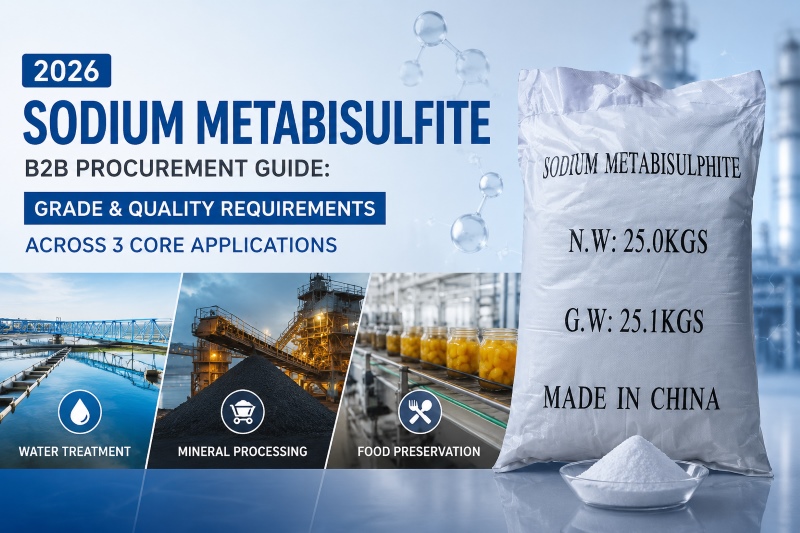
As a versatile industrial chemical, sodium metabisulfite (Na₂S₂O₅) plays an important role in mineral processing, oilfield operations, wastewater treatment, and reverse osmosis (RO) systems. However, industrial buyers often make the mistake of treating sodium metabisulfite as a standard commodity without matching its specifications to the intended application.
A key procurement question is: How much do purity, impurity limits, solubility, and particle size requirements vary when sourcing sodium metabisulfite for mining, oilfield drilling, or water treatment?
Choosing an unnecessarily high-purity grade can increase purchasing costs. On the other hand, an under-specified material may reduce process efficiency or create compliance and equipment risks. Therefore, an application-based sodium metabisulfite procurement strategy helps buyers balance chemical performance, supply reliability, and total operating costs.
1. Sodium Metabisulfite for Mining & Mineral Beneficiation
In mining and mineral beneficiation, sodium metabisulfite for mining is commonly used as a depressant and sulfur dioxide donor. It can support copper-lead-zinc flotation separation and cyanide destruction processes, including the INCO SO₂/Air process.
Key Procurement Requirements
For large-scale mining operations, procurement teams should focus on assay consistency, impurity control, storage stability, and bulk handling performance.
| Procurement Parameter | Recommended Requirement | Why It Matters |
|---|---|---|
| Na₂S₂O₅ Purity | ≥ 96.5%–97.5% | Provides consistent reaction performance at high consumption volumes |
| Iron Content | Fe ≤ 15–50 ppm | Helps minimize interference with mineral surface chemistry |
| Moisture Control | Low moisture, anti-caking performance | Prevents clumping during storage and automatic feeding |
| Particle Size | Coarse or standard mesh | Suitable for bulk reagent feeding systems |
| Packaging | 1000 kg jumbo bags with moisture liner | Supports large-volume transportation and storage |
For most mineral processing applications, a technical-grade sodium metabisulfite with an assay of approximately ≥96.5%–97.0% can provide a practical balance between chemical performance and procurement cost.
Because mining chemicals are often stored in challenging environments, moisture resistance is equally important. Anti-caking packaging helps maintain free-flowing characteristics and prevents feeding problems in automated dosing systems.
2. Sodium Metabisulfite for Oilfield & Gas Well Drilling
The requirements change when sodium metabisulfite for oilfield applications is used as an oxygen scavenger or as an intermediate for producing specialty oilfield chemicals.
Compared with mining applications, dissolution performance and trace impurity control become more important.
Key Technical Criteria
Fast dissolution is essential when chemical solutions must be prepared quickly at offshore rigs or remote drilling locations. Fine granular or rapid-dissolving grades can minimize undissolved particles and help prevent blockages in pumping equipment.
In addition, residual heavy metals require close attention. When sodium metabisulfite is used as a raw material for downhole chemicals, excessive trace metals may interfere with chemical stability and polymer performance under high-temperature and high-pressure (HTHP) conditions.
For these applications, buyers should evaluate:
- Purity: High-purity technical grade, typically ≥97.5%
- Particle size: Fine granular material for rapid dissolution
- Heavy metals: Controlled Fe, Pb, and other trace impurities
- Insolubles: Low insoluble content
- Packaging: 25 kg PE-lined bags or bulk Super Sacks
Therefore, an industrial sodium metabisulfite supplier should be able to provide consistent lot-to-lot specifications rather than simply supplying material based on nominal purity.
3. Sodium Metabisulfite for Water Treatment & RO Dechlorination
Water treatment is another major application for sodium metabisulfite. In municipal wastewater treatment and reverse osmosis desalination systems, it acts as a reducing agent to remove residual chlorine before water enters sensitive RO membranes.
Polyamide RO membranes are particularly vulnerable to chlorine oxidation. Therefore, reliable dechlorination requires consistent sodium metabisulfite quality and accurate dosing.
Key Procurement Requirements
For sodium metabisulfite for water treatment, impurity control becomes more stringent than in many general industrial applications.
| Procurement Parameter | Water Treatment Requirement | Application Benefit |
|---|---|---|
| Na₂S₂O₅ Assay | ≥98.0% for high-purity/food-grade applications | Supports accurate chemical dosing |
| Heavy Metals | Strict control | Reduces contamination and fouling risks |
| Arsenic & Lead | Low trace levels | Important for regulated water applications |
| Insolubles | Low | Helps protect dosing and filtration systems |
| Particle Size | Standard or fine granular | Supports rapid and consistent dissolution |
| Compliance | NSF/ANSI Standard 60 or equivalent where applicable | Supports potable-water treatment requirements |
| Packaging | Sealed PE-lined moisture-resistant bags | Protects product quality during storage |
For potable-water applications, buyers should not evaluate sodium metabisulfite based on assay alone. Applicable regulatory requirements, impurity limits, certificates, and intended water-contact use must also be verified.
4. Sodium Metabisulfite Grade Comparison by Application
Matching the chemical specification to the actual process helps B2B buyers avoid both over-specification and under-specification.
| Procurement Dimension | Mining & Mineral Beneficiation | Oilfield & Drilling | Water Treatment & RO |
|---|---|---|---|
| Primary Function | Cyanide destruction, pyrite depressant | Oxygen scavenger, chemical intermediate | Chlorine reduction, RO membrane protection |
| Typical Purity | ≥96.5%–97.0% | ≥97.5% | ≥98.0% for high-purity/food-grade applications |
| Particle Size | Coarse / standard mesh | Fine granular | Standard / fine granular |
| Main Quality Focus | Moisture, bulk density, anti-caking | Solubility, heavy metals, insolubles | Heavy metals, arsenic, lead, insolubles |
| Storage Requirement | Moisture-resistant bulk packaging | PE-lined bags or Super Sacks | Sealed moisture-resistant packaging |
| Typical Packaging | 1000 kg jumbo bags | 25 kg bags / Super Sacks | Sealed PE-lined bags |
| Key Procurement Priority | Cost efficiency and bulk stability | Dissolution and synthesis consistency | Purity and regulatory compliance |
This comparison shows why there is no single best sodium metabisulfite grade for every industrial application. The appropriate specification depends on the process chemistry, dosing method, storage environment, and regulatory requirements.
5. How B2B Buyers Should Specify Sodium Metabisulfite
A clear purchasing specification can significantly reduce quality disputes and unnecessary costs. Before requesting a quotation, procurement teams should define the following parameters.
1. Confirm the Application
Clearly state whether the product will be used for mineral flotation, cyanide destruction, oilfield chemical synthesis, wastewater treatment, or RO dechlorination.
2. Define the Required Purity
Specify the minimum Na₂S₂O₅ assay rather than requesting simply “industrial grade.” For example, mining applications may prioritize ≥96.5%–97.0%, while higher-purity water treatment applications may require ≥98.0%.
3. Set Impurity Limits
For sensitive applications, request limits for iron, lead, arsenic, insolubles, and other relevant trace impurities.
4. Specify Particle Size and Dissolution Requirements
Particle size directly affects dissolution and dosing behavior. Fine granular grades may be preferable for applications requiring rapid preparation.
5. Confirm Packaging and Storage Conditions
For long-distance shipping or humid environments, moisture-resistant PE liners and anti-caking packaging can help maintain product quality.
6. Request Lot-Level Documentation
A reliable supplier should provide a Certificate of Analysis (COA) showing assay, moisture, impurities, and other agreed quality parameters for each production lot.
6. SXS Industrial Sodium Metabisulfite Supply Solutions
SXS provides industrial sodium metabisulfite for mining, oilfield, water treatment, and other industrial processing applications. Its product portfolio can be configured according to application-specific purity, impurity, particle-size, packaging, and logistics requirements.
Key supply capabilities include:
- Application-Specific Grades: Technical grades for mineral processing and higher-purity grades for water treatment and other demanding applications.
- Consistent Quality Control: Production testing focuses on assay consistency, impurity control, moisture, and dissolution performance.
- Flexible Packaging: Available in 25 kg moisture-resistant bags, 1000 kg jumbo bags, Super Sacks, and customized private-label packaging.
- B2B Bulk Supply: Designed for mining companies, oilfield service providers, water treatment operators, chemical distributors, and industrial buyers.
- Global Logistics Support: Packaging and shipment configurations can be adapted for long-distance ocean freight and remote project delivery.
Technical Summary
Choosing the right sodium metabisulfite grade requires an application-driven approach rather than a simple price comparison. Mining operations typically prioritize bulk supply stability, anti-caking performance, and cost-efficient technical grades. Oilfield applications place greater emphasis on rapid dissolution, purity, and trace-metal control. Water treatment and RO systems require consistent assay, strict impurity limits, and applicable regulatory compliance.
For B2B buyers, the most effective procurement strategy is to define the required purity, particle size, impurity limits, packaging, and documentation before placing a bulk order. Working with an experienced sodium metabisulfite supplier such as SXS can help industrial users achieve more consistent chemical performance while controlling procurement and logistics costs.