


Sodium Metabisulfite in Seawater Cu-Mo Flotation: Why Molybdenite Recovery Changes
In copper-molybdenum (Cu-Mo) mineral processing, Sodium Metabisulfite (Na₂S₂O₅, MBS) is widely used as a selective depressant for iron sulfides such as pyrite and for chalcopyrite in differential froth flotation. However, its effect on molybdenite can vary significantly depending on the flotation water chemistry.
This difference creates what metallurgists and process engineers often describe as the “Seawater Paradox.”
A key process question is: Why can Sodium Metabisulfite strongly depress molybdenite recovery in freshwater, especially for fine particles, while maintaining high molybdenum recovery in seawater flotation circuits?
The answer is closely related to ionic strength, dissolved divalent cations, sulfite speciation, and mineral surface interactions. Understanding these factors helps concentrator operators optimize Sodium Metabisulfite dosage, maintain molybdenite recovery, and improve selective pyrite depression.
1. Freshwater Flotation: How Sodium Metabisulfite Can Depress Molybdenite
In conventional freshwater flotation, Sodium Metabisulfite rapidly hydrolyzes into bisulfite and sulfite species:
Na2S2O5+H2O→2Na++2HSO3−\text{Na}_2\text{S}_2\text{O}_5 + \text{H}_2\text{O} \rightarrow 2\text{Na}^+ + 2\text{HSO}_3^-
These dissolved sulfite species can interact with mineral surfaces and influence the natural floatability of molybdenite.
Sulfite Interaction with Molybdenite Edges
Molybdenite (MoS₂) has an anisotropic crystal structure. Its basal faces are naturally hydrophobic, while its exposed edges are comparatively hydrophilic.
In low-ionic-strength freshwater, the following mechanism can become important:
- Sulfite Interaction: Free bisulfite and sulfite ions can interact with metal cations and oxygen-containing species at the hydrophilic edges of molybdenite.
- Surface Passivation: These interactions can reduce the hydrophobic response of the mineral surface.
- Fine-Particle Sensitivity: Fine molybdenite particles below 20 μm have a higher edge-to-face ratio. Therefore, surface interactions can have a greater impact on their flotation behavior.
As a result, excessive or poorly controlled Sodium Metabisulfite dosage may reduce molybdenite floatability and increase the risk of fine molybdenum losses to tailings.
2. The Seawater Paradox: Why Flotation Behavior Changes
When a Cu-Mo flotation circuit uses seawater or high-salinity recycled process water, the chemical environment changes substantially.
Seawater contains a much higher concentration of dissolved ions than freshwater. In particular, calcium (Ca²⁺) and magnesium (Mg²⁺) can interact with sulfite species generated from Sodium Metabisulfite.
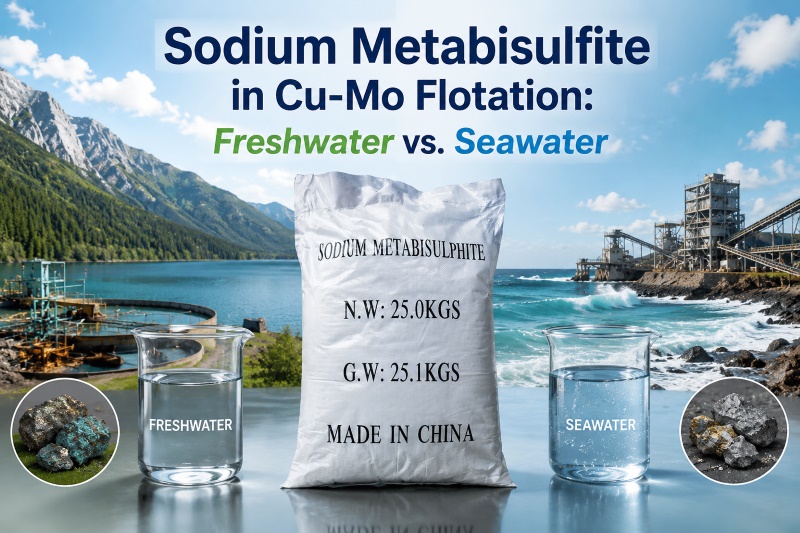
Freshwater vs. Seawater Flotation Environment
                  FLOTATION WATER CHEMISTRY

  Freshwater Environment
  ├── Low ionic strength
  ├── More unbound sulfite / bisulfite species
  ├── Greater interaction with molybdenite edges
  └── Higher risk of molybdenite depression

  Seawater Environment
  ├── High ionic strength
  ├── Abundant Ca²⁺ and Mg²⁺ ions
  ├── Competitive sulfite ion interactions
  └── Molybdenite floatability is better preserved
Role of Calcium and Magnesium Ions
When Sodium Metabisulfite is added to seawater, sulfite species interact with the abundant dissolved ions in the process water.
This can influence the availability of sulfite species in the bulk solution:
- Ion Pairing and Complexation: Sulfite species can interact with Ca²⁺ and Mg²⁺, forming soluble complexes or micro-precipitates such as CaSO₃ and MgSO₃.
- Reduced Edge Interaction: The consumption or association of sulfite species in the bulk water can reduce their direct interaction with molybdenite polar edges.
- Selective Pyrite Depression: At the same time, the reducing environment generated by MBS remains active. This supports pyrite depression while allowing molybdenite to retain its natural hydrophobicity.
Therefore, seawater chemistry can change the selectivity of Sodium Metabisulfite flotation, reducing its negative impact on molybdenite recovery while maintaining effective pyrite depression.
3. Freshwater vs. Seawater: Sodium Metabisulfite Flotation Performance
Understanding the difference between water chemistries is essential when designing or optimizing a Cu-Mo flotation process.
| Process Variable | Freshwater Cu-Mo Flotation | Seawater Cu-Mo Flotation |
|---|---|---|
| Dominant Sulfite Species | Unbound HSO₃⁻ / SO₃²⁻ | Complexed CaSO₃ / MgSO₃ ion pairs |
| Pyrite (FeS₂) Depression | Highly effective | Highly effective |
| Molybdenite (MoS₂) Impact | Strong depression; collector adjustment may be required | Minimal to zero depression; floatability is better preserved |
| Fine Particle (<20 μm) Recovery | Low; greater edge passivation risk | High; natural face/edge behavior is better preserved |
| MBS Process Value | Requires tight dosage control to minimize Mo losses | Highly useful selective depressant for coastal flotation operations |
This comparison shows why water chemistry should be considered alongside reagent dosage when selecting Sodium Metabisulfite for mineral processing.
4. What This Means for Cu-Mo Flotation Process Control
For concentrator operators, the key issue is not simply whether to use Sodium Metabisulfite. Instead, the process should consider how MBS interacts with the specific flotation water.
1. Control MBS Dosage in Freshwater Circuits
Freshwater circuits require careful reagent control because excessive sulfite availability may negatively affect molybdenite floatability.
Operators should therefore monitor:
- MBS dosage
- Pulp chemistry
- ORP conditions
- Molybdenite recovery
- Fine-particle recovery
- Pyrite depression performance
2. Consider Water Chemistry When Using Seawater
Seawater flotation introduces higher concentrations of Ca²⁺, Mg²⁺, and other dissolved ions. These ions can change sulfite behavior and therefore influence reagent selectivity.
For coastal and seawater-based concentrators, understanding these interactions can help engineers optimize Sodium Metabisulfite consumption and Cu-Mo separation performance.
3. Monitor Fine Molybdenite Recovery
Fine molybdenite particles below 20 μm are particularly sensitive to surface chemistry because of their higher edge-to-face ratio.
Maintaining favorable surface conditions is therefore essential for reducing fine molybdenum losses during differential flotation.
5. SXS Industrial-Grade Sodium Metabisulfite for Mineral Processing
SXS provides industrial-grade Sodium Metabisulfite (Na₂S₂O₅) for mining, mineral processing, and industrial water treatment applications.
The product is designed to provide consistent reagent performance for flotation operations where stable chemical quality and reliable supply are essential.
Consistent Chemical Quality
SXS Sodium Metabisulfite is manufactured with high active purity and controlled insoluble content. Consistent quality helps metallurgical teams maintain predictable reagent performance and ORP reduction during flotation.
Packaging for Global Mining Operations
Sodium Metabisulfite can be supplied in 25 kg moisture-proof bags or 1,000 kg super-sacks. These packaging options are designed for international transportation and long-term storage at mining and mineral processing sites.
Technical Support and Batch Traceability
SXS supports B2B mining customers with batch traceability and technical consultation. This allows process engineers to evaluate reagent performance under different water chemistry and dosage conditions.
Summary: Sodium Metabisulfite Selectivity in Seawater Flotation
The “Seawater Paradox” demonstrates that the flotation behavior of Sodium Metabisulfite depends strongly on the surrounding water chemistry.
In freshwater Cu-Mo flotation, free sulfite and bisulfite species can interact with molybdenite edges and potentially reduce molybdenite recovery, particularly for fine particles below 20 μm.
In seawater flotation, abundant Ca²⁺ and Mg²⁺ ions alter sulfite interactions in the aqueous phase. This can reduce direct sulfite interaction with molybdenite surfaces while allowing MBS to maintain effective pyrite depression.
For coastal copper-molybdenum concentrators, this makes Sodium Metabisulfite a valuable selective depressant when properly matched to water chemistry, reagent dosage, and flotation conditions.
SXS supplies industrial-grade Sodium Metabisulfite for global mining and mineral processing operations, with consistent chemical quality, moisture-resistant packaging, batch traceability, and technical support for flotation reagent applications.