



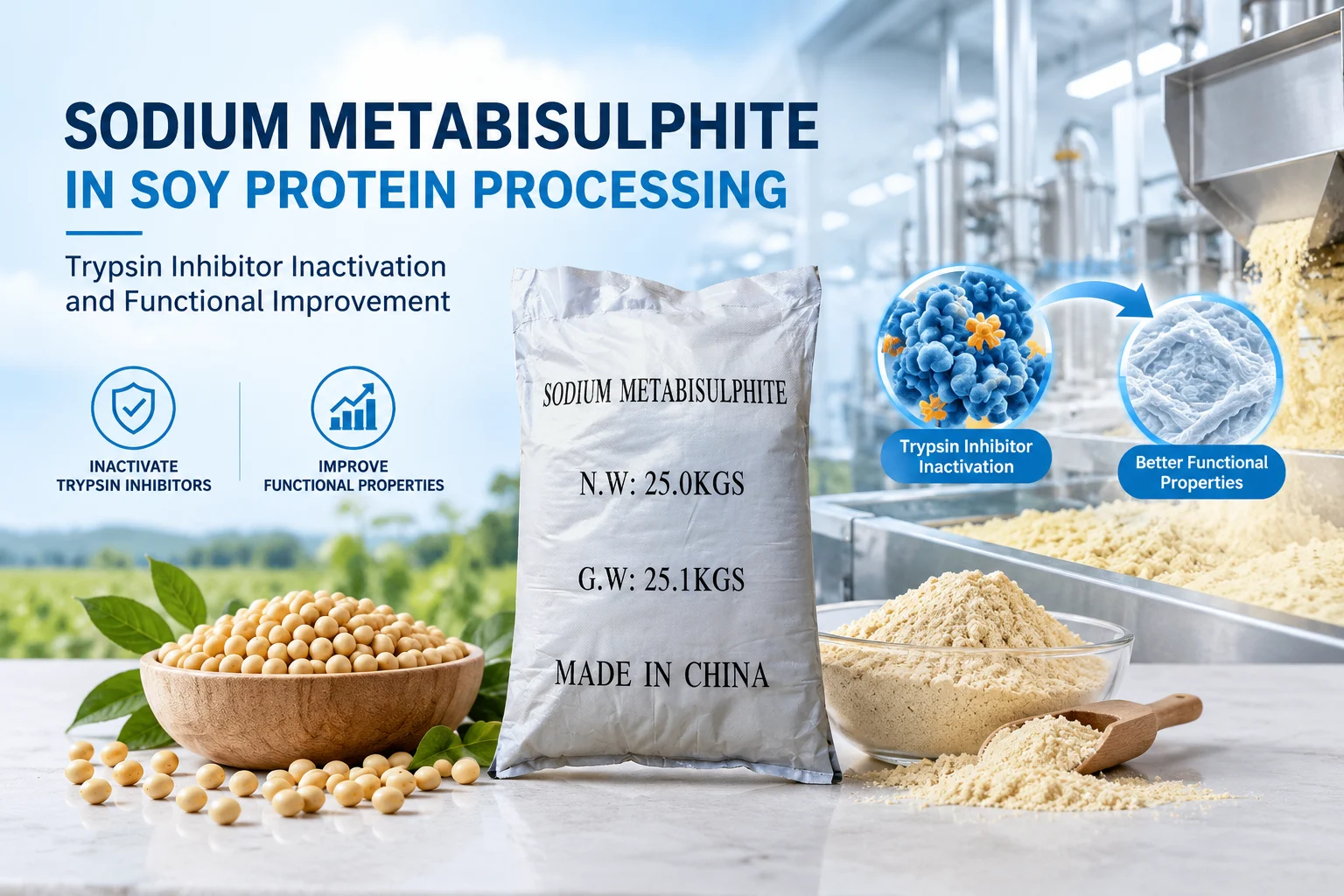
Sodium Metabisulfite in Soy Protein Processing: Inactivating Trypsin Inhibitors
For plant-based protein manufacturers, soy ingredient suppliers, and food R&D teams, controlling anti-nutritional factors remains a key processing challenge.
Soy protein isolate (SPI) and soy protein concentrate (SPC) contain soybean trypsin inhibitors (STI). These inhibitors can reduce protein digestibility and nutrient absorption.
The two major STI types are Kunitz inhibitors and Bowman-Birk inhibitors. Their stable structures make effective inactivation difficult during soy protein processing.
Traditional facilities often use intensive thermal processing to reduce trypsin inhibitor activity. Common methods include high-temperature steam injection and jet cooking.
However, excessive heat can cause severe protein denaturation. This may reduce solubility, emulsification capacity, and foaming performance.
This creates a major processing challenge for soy protein manufacturers. They need to reduce anti-nutritional factors without sacrificing functional protein properties.
Recent research has highlighted sodium metabisulfite in soy protein processing as a potential non-thermal modification method. A 2025 study published in the International Journal of Biological Macromolecules demonstrated this approach.
The method uses chemical sulfitolysis to cleave disulfide bonds in trypsin inhibitors. It can also modify soy protein functionality under mild processing conditions.
1. Why Soybean Trypsin Inhibitors Are Difficult to Remove
Soybean trypsin inhibitors have compact protein structures. Internal disulfide bonds help maintain their rigid and stable configurations.
These structures allow STI proteins to resist conventional processing conditions. As a result, incomplete inactivation can remain a concern for soy protein manufacturers.
The primary processing objective is therefore twofold:
- Reduce trypsin inhibitor activity.
- Preserve desirable soy protein functionality.
High-temperature processing can achieve substantial inhibitor inactivation. However, prolonged or excessive heating can also promote protein aggregation.
This aggregation can negatively affect protein solubility and interfacial properties.
For this reason, chemical modification provides an alternative processing pathway worth evaluating.
2. How Sodium Metabisulfite Inactivates Soybean Trypsin Inhibitors
Disulfide Bond Cleavage Through Sulfitolysis
Soybean trypsin inhibitors maintain their rigid structures through internal disulfide bonds.
These S-S bonds help stabilize the native protein configuration. Breaking these bonds can disrupt the structure required for enzyme inhibition.
When sodium metabisulfite ($Na_2S_2O_5$) is introduced during mild wet processing, it dissociates into active bisulfite and sulfite species.
The sulfite ions can participate in a selective sulfitolysis reaction.
The simplified reaction can be represented as:
R−S−S−R+HSO3−→R−S−H+R−S−SO3−R-S-S-R + HSO_3^- \rightarrow R-S-H + R-S-SO_3^-
The reaction cleaves critical disulfide bridges within the inhibitor structure.
This disrupts the compact configuration of the trypsin inhibitor. The resulting structural changes reduce its ability to bind digestive enzymes.
From Rigid STI to a Modified Protein Structure
The processing mechanism can therefore be summarized in three stages:
| Processing Stage | Structural Change |
|---|---|
| Active Trypsin Inhibitor | Internal disulfide bonds maintain the rigid native structure |
| Sodium Metabisulfite Treatment | Sulfite species promote sulfitolysis and disulfide bond cleavage |
| Modified STI Structure | Disulfide bonds convert into S-sulfonate groups and the structure unfolds |
This chemical route reduces the need for sustained high-temperature treatment.
3. How Sodium Metabisulfite Can Improve Soy Protein Functionality
The benefits of sodium metabisulfite in soy protein processing extend beyond trypsin inhibitor inactivation.
Chemical modification can also affect the molecular conformation of soy globulins.
The two major soy protein fractions are:
- Glycinin (11S)
- β-Conglycinin (7S)
Structural modification can expose functional groups that were previously buried within the protein structure.
This can improve several properties that are important for food formulation.
3.1 Improved Emulsification Capacity and Stability
Partial protein unfolding can expose hydrophobic amino acid residues.
These newly exposed regions can promote protein migration toward oil-water interfaces.
As a result, the modified proteins can show improved emulsifying activity and stability.
These properties are valuable in applications such as:
- Plant-based dairy products
- Meat analog formulations
- Protein beverages
- Emulsion-based food systems
The improvement can support formulations that require stable protein-oil interactions.
3.2 Enhanced Foaming Capacity
Disulfide bond cleavage can increase protein chain flexibility.
More flexible protein molecules can migrate rapidly toward air-water interfaces during whipping.
This behavior can improve both foaming capacity and foam stability.
Potential applications include:
- Bakery formulations
- Whipped plant-based products
- Foamed food systems
- Plant-based dessert products
3.3 Maintaining Low Residual SO₂ Levels
Food safety and regulatory compliance remain important for food R&D teams.
According to the research described in the original process, standard washing, flash evaporation, or spray drying can reduce residual sulfur dioxide ($SO_2$).
The reported final residual level is below 30 mg/kg.
This level is described as being well below applicable US FDA and EU regulatory thresholds for food ingredients.
Actual compliance should still be evaluated against the specific product, process, market, and applicable regulations.
4. Thermal Processing vs. Sodium Metabisulfite Modification
Traditional thermal processing and sodium metabisulfite-assisted processing use different mechanisms.
Thermal treatment relies on heat-induced protein denaturation. Sodium metabisulfite modification relies on chemical sulfitolysis.
This difference can influence both protein functionality and processing requirements.
| Processing Parameter | Traditional Thermal Inactivation | Sodium Metabisulfite-Assisted Processing |
|---|---|---|
| Primary Inactivation Mechanism | Thermal protein denaturation | Chemical sulfitolysis and disulfide bond cleavage |
| Energy Consumption | High; requires sustained high heat or steam | Low; operates under mild temperature conditions |
| Protein Nitrogen Solubility Index (NSI) | Poor; severe thermal aggregation may occur | High; preserves native or unfolded solubility |
| Emulsifying Performance | Degraded due to lost surface activity | Significantly enhanced through exposed hydrophobic sites |
| Foaming Performance | Degraded by excessive thermal treatment | Significantly enhanced through greater protein flexibility |
| Trypsin Inhibitor Inactivation Rate | High, approximately 85%–95% | High, approximately 85%–92% |
| Residual SO₂ | None, 0 mg/kg | Minimal, below 30 mg/kg |
This comparison highlights the potential functional advantage of chemical modification.
The key objective is not simply maximum inhibitor removal. Protein functionality must also remain suitable for the final food application.
5. Why Food-Grade Sodium Metabisulfite Matters for Soy Processing
For soy protein manufacturers, chemical modification requires consistent raw material quality.
The performance of sodium metabisulfite depends on factors such as purity, dissolution, and impurity control.
Food-grade material is therefore important for controlled processing.
High-Purity Chemical Performance
Consistent sulfitolysis requires reliable active purity.
Low heavy metal content is also important for food ingredient applications.
Stable dissolution characteristics can support more consistent processing conditions.
Potential Processing Cost Reduction
Replacing intensive thermal stages with mild chemical treatment can reduce energy requirements.
Lower thermal demand may also help reduce overall utility consumption.
For large-scale facilities, these changes can contribute to lower processing costs and reduced operational carbon footprints.
Premium Functional Soy Protein Development
Chemical modification can support the development of functional soy protein ingredients.
Potential products include high-solubility and high-foaming soy protein isolates.
These ingredients can target higher-value applications such as:
- Plant-based beverages
- Sports nutrition powders
- Meat alternatives
- Plant-based dairy products
6. Key Procurement Considerations for Soy Protein Processors
Before selecting a food-grade sodium metabisulfite supplier, procurement teams should evaluate both chemical quality and supply capabilities.
Active Assay Purity
High active purity supports predictable processing performance.
Suppliers should provide clear product specifications and batch documentation.
Heavy Metal Control
Low heavy metal content is important for food and beverage processing.
Procurement teams should review relevant specifications and Certificates of Analysis (CoA).
Dissolution Performance
Reliable dissolution helps maintain consistent chemical distribution during wet processing.
This is especially important for large-scale production.
Food Safety Certifications
Food-grade chemical suppliers should provide appropriate quality and food safety certifications.
These documents help manufacturers evaluate supplier suitability for regulated food applications.
Bulk Packaging and Logistics
Large food ingredient manufacturers may require stable bulk supply.
Common packaging formats include:
- 25kg bags
- 1000kg jumbo bags
Flexible packaging can support different production and transportation requirements.
SXS High-Purity Food-Grade Sodium Metabisulfite
SXS manufactures and wholesales high-purity food-grade sodium metabisulfite (Na_2S_2O_5) for global food processors, ingredient manufacturers, and industrial chemical distributors.
The product is designed for applications requiring consistent chemical quality and reliable bulk supply.
Strict Quality and Food Safety Standards
SXS supports food ingredient manufacturing with multiple quality and food safety certifications.
These include:
- ISO 9001
- ISO 22000
- FSSC 22000
- Kosher
- Halal
These certifications provide procurement teams with additional documentation for supplier evaluation.
Consistent Chemical Performance
SXS focuses on high active assay purity and reliable dissolution.
Strict heavy metal controls also support food and beverage applications.
Consistent chemical specifications can help manufacturers maintain stable processing conditions.
Flexible Bulk Sourcing
SXS supports international buyers with flexible packaging solutions.
Available options include 25kg bags and 1000kg jumbo bags.
The company also supports international supply chain requirements for global importers and distributors.
8. Conclusion: Sodium Metabisulfite as a Non-Thermal Soy Protein Processing Option
Sodium metabisulfite in soy protein processing provides an alternative approach to managing soybean trypsin inhibitors.
The process uses sulfitolysis to cleave disulfide bonds within STI structures.
This chemical modification can reduce inhibitor activity under mild processing conditions.
At the same time, structural modification can improve protein solubility, emulsification, and foaming performance.
The reported trypsin inhibitor inactivation rate reaches approximately 85%–92% with sodium metabisulfite-assisted processing.
The reported residual $SO_2$ level can also remain below 30 mg/kg after standard downstream processing.
For plant-based protein manufacturers, this approach offers potential opportunities to reduce thermal processing intensity.
It may also support the development of higher-value functional soy protein ingredients.
However, process conditions and regulatory compliance should always be validated for the specific food application.
Partner with SXS for Food-Grade Sodium Metabisulfite
SXS supplies high-purity food-grade sodium metabisulfite for food processors, ingredient manufacturers, and chemical distributors.
From product specifications and CoA documentation to bulk packaging and international logistics, SXS supports B2B sourcing requirements.