


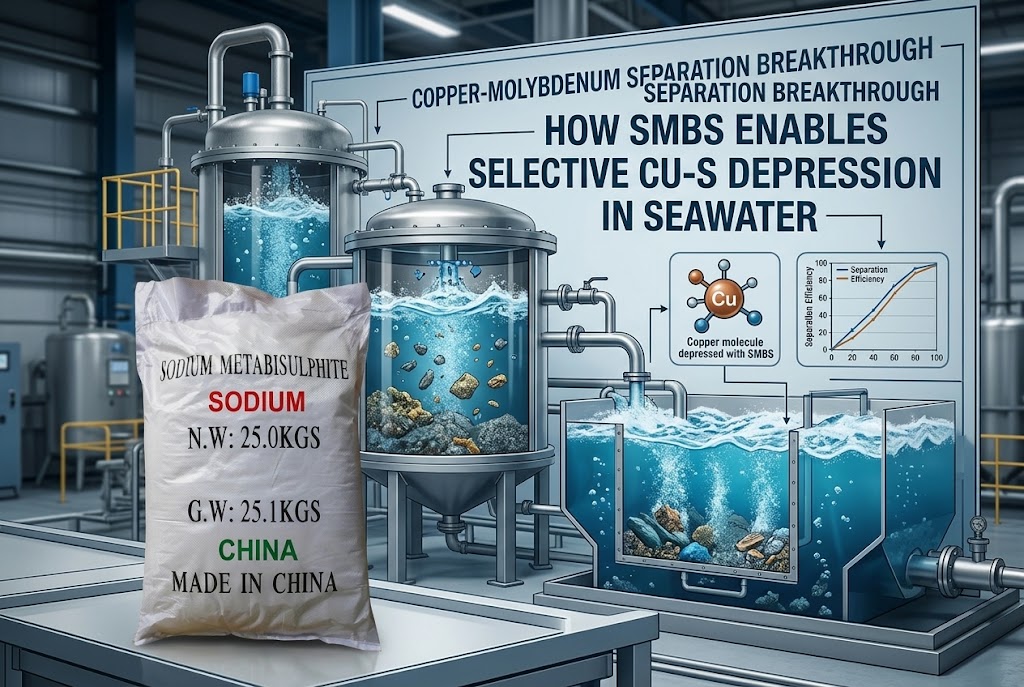
Flotation engineers and mining plant managers operating copper-molybdenum (Cu-Mo) processing facilities face a critical challenge: How can plants achieve efficient chalcopyrite depression during Cu-Mo separation in seawater without sacrificing valuable molybdenite recovery?
As freshwater scarcity continues to increase across major mining regions in Central Asia, South America, and Africa, more coastal and arid mining operations are turning to seawater flotation. However, seawater contains high concentrations of dissolved ions, including Na+, Mg2+, Ca2+, Cl-, and SO4²⁻. As a result, these ions can significantly affect collector adsorption, mineral surface chemistry, and flotation selectivity.
Therefore, high-purity sodium metabisulfite for copper-molybdenum flotation provides an alternative depressant strategy for selective mineral separation. Sodium metabisulfite (Na2S2O5) can help suppress chalcopyrite (CuFeS2) and pyrite (FeS2) while maintaining the natural hydrophobicity and recovery potential of molybdenite (MoS2).
This technical guide explains the chemical mechanisms of sodium metabisulfite in seawater flotation. In addition, it examines XPS surface analysis, compares freshwater and seawater flotation behavior, and provides practical dosage guidelines for Cu-Mo mineral processing plants.
1. The Chemical Challenge of Cu-Mo Separation in Seawater
In copper-molybdenum bulk concentrates, both chalcopyrite and molybdenite can exhibit strong natural or collector-induced hydrophobicity. Therefore, selective separation requires the flotation circuit to depress copper and iron sulfides while allowing molybdenite to remain floatable.
However, seawater introduces additional challenges because its high ionic strength changes the surface chemistry of sulfide minerals.
Freshwater vs. Seawater Flotation
| Operating Condition | Freshwater System | Seawater System |
|---|---|---|
| Ionic Strength | Low background salinity | High concentrations of dissolved Mg2+, Ca2+, Na+, and Cl- |
| Molybdenite Recovery | High natural edge/face anisotropy | Mg/Ca hydroxides can coat edges at alkaline pH (>9.5), potentially reducing flotation |
| Depressant Response | Standard inorganic depressants such as NaHS or cyanide may be used | Requires tailored bisulfite/sulfite dosage to maintain selectivity |
| Environmental Consideration | Higher toxic wastewater concerns with certain depressants | Sodium metabisulfite provides an alternative inorganic depressant approach |
| Process Consideration | Relatively straightforward surface chemistry | High salinity requires closer control of pH, dosage, and ORP |
Consequently, selecting an appropriate depressant becomes particularly important when a flotation plant uses seawater as its process water.
Why Sodium Metabisulfite Is Used for Cu-Mo Flotation
Traditional sodium hydrosulfide (NaHS) depressants can generate hazardous hydrogen sulfide (H2S) under unsuitable operating conditions. In addition, high-salinity flotation circuits may require careful reagent management.
For this reason, high-grade sodium metabisulfite for copper molybdenum flotation can serve as a more stable inorganic reagent option.
When dissolved in water, sodium metabisulfite (Na2S2O5) forms bisulfite (HSO3-) and sulfite (SO3²⁻) species. These sulfite-based species can interact with collector species on chalcopyrite surfaces and promote the removal or transformation of hydrophobic surface species.
At the same time, molybdenite has naturally hydrophobic basal planes. Therefore, properly controlled sodium metabisulfite conditioning can support selective depression of copper-iron sulfides while preserving molybdenite flotation.
2. Surface Mechanisms: XPS Analysis of Chalcopyrite Depression
To better understand the interaction between sodium metabisulfite and sulfide minerals, researchers can use surface characterization methods such as X-ray Photoelectron Spectroscopy (XPS) and electrochemical measurements.
These techniques help identify changes in surface composition, oxidation states, collector species, and hydrophilic surface products.
2.1 Desorption of Collector Species and Xanthate Decomposition
One important mechanism involves the interaction between sulfite species and hydrophobic collector products.
Sulfite ions (SO3²⁻) generated from sodium metabisulfite can act as reducing agents. They can react with dixanthogen, a hydrophobic species associated with chalcopyrite flotation, and promote its conversion toward soluble monoxanthate species.
The simplified reaction can be represented as:
As the hydrophobic dixanthogen layer is removed or transformed, the chalcopyrite surface becomes more hydrophilic. Consequently, chalcopyrite flotation can be suppressed.
2.2 Surface Oxidation and Hydrophilic Hydroxide Formation
In addition to collector decomposition, surface oxidation plays an important role in chalcopyrite depression.
XPS analysis of chalcopyrite treated with sodium metabisulfite in seawater can reveal changes in iron, sulfur, and copper surface species.
Key observations include:
- Fe 2p3/2 peak shift: This can indicate transformation of surface iron sulfide species (Fe-S) toward hydrophilic iron hydroxide species such as Fe(OH)3 and FeOOH.
- S 2p spectrum transformation: Changes can indicate a reduction in hydrophobic elemental sulfur (S0) and polysulfide species (Sn²⁻), together with the formation of more hydrophilic sulfur-oxygen species such as sulfate (SO4²⁻) and thiosulfate (S2O3²⁻).
Therefore, sodium metabisulfite conditioning can modify the surface chemistry of chalcopyrite and contribute to its reduced floatability.
2.3 Why Molybdenite Can Maintain Selectivity in Seawater
Molybdenite has a highly anisotropic crystal structure. Its basal planes are naturally hydrophobic, while its polar edges are comparatively hydrophilic.
In freshwater systems, excessive depressant concentration can sometimes interact with molybdenite edge sites. As a result, uncontrolled reagent addition may reduce molybdenite recovery.
In seawater, however, dissolved background ions such as Na+ and Cl- can compress the electrical double layer around mineral particles. This ionic shielding can affect reagent adsorption behavior and surface interactions.
Consequently, under appropriately controlled conditions, sodium metabisulfite can provide selective depression of chalcopyrite and pyrite while maintaining the hydrophobicity of molybdenite basal planes.
For this reason, sodium metabisulfite for copper molybdenum flotation can be considered when designing seawater-based Cu-Mo separation circuits.
3. SXS High-Purity Sodium Metabisulfite Specifications
SXS manufactures industrial-grade sodium metabisulfite for copper molybdenum flotation, designed for rapid dissolution and consistent redox potential (ORP) control in mineral processing circuits.
3.1 Technical Product Parameters
| Parameter | SXS Specification |
|---|---|
| Chemical Formula | Na2S2O5 |
| Na2S2O5 Purity / Assay | ≥97.5% |
| Active SO2 Content | ≥65.5% |
| Iron (Fe) Content | ≤0.0015% |
| Water-Insoluble Matter | ≤0.02% |
The low iron content helps reduce unwanted mineral surface contamination. Meanwhile, the low level of water-insoluble matter supports cleaner reagent preparation and dosing.
As a result, these specifications are suitable for mineral processing operations where reagent consistency and process control are important.
3.2 Key Advantages for Mining Applications
Controlled Oxidation-Reduction Potential
Sodium metabisulfite can help lower slurry ORP into a controlled depression range. The specified operating window is approximately -100 mV to -250 mV vs. SHE, depending on circuit conditions.
This ORP control is important because flotation selectivity depends on the interaction between reagent chemistry, mineral surfaces, pH, and redox conditions.
Reduced Risk of Toxic Gas Generation
Unlike NaHS-based depressant systems, sodium metabisulfite does not rely on sulfide chemistry for chalcopyrite depression.
Under controlled operating conditions and a slurry pH of approximately 7.5-9.0, SXS sodium metabisulfite can provide a safer reagent-handling option without intentionally generating H2S.
Therefore, appropriate reagent selection can contribute to improved operational control and workplace safety.
4. Operational Guidelines for Seawater Cu-Mo Flotation
To maximize molybdenum grade and recovery while selectively depressing copper and iron sulfides, metallurgy teams should control several key operating parameters.
| Operational Parameter | Recommended Circuit Value | Metallurgical Rationale |
|---|---|---|
| Slurry pH | 7.5-9.0 | Helps avoid excessive Mg(OH)2 precipitation on molybdenite while maintaining active HSO3- species |
| Sodium Metabisulfite Dosage | 500-1500 g/t feed | Provides sufficient SO3²⁻ species to promote collector decomposition without excessive reagent consumption |
| Conditioning Time | 5-12 minutes | Provides sufficient time for surface reactions before subsequent flotation stages |
| Target ORP | -150 to -200 mV | Maintains the specified selective depression range for copper and iron sulfides |
However, these values should be treated as starting points rather than universal settings. Actual dosage and conditioning conditions should be optimized through laboratory flotation tests, ore characterization, seawater chemistry analysis, and plant-scale trials.
In particular, ore mineralogy, collector type, pulp density, pH, seawater composition, and circuit configuration can all influence the required sodium metabisulfite dosage.
5. How to Optimize Sodium Metabisulfite Dosage in a Cu-Mo Circuit
Because flotation chemistry varies between ore bodies, simply increasing depressant dosage does not necessarily improve separation efficiency.
Instead, metallurgy teams should optimize the reagent systematically.
Step 1: Establish the Baseline
First, measure the flotation performance of the existing circuit. Important indicators include:
- Copper recovery
- Molybdenum recovery
- Copper grade
- Molybdenum grade
- Pulp pH
- ORP
- Collector dosage
- Frother dosage
This baseline provides a reference for evaluating the effect of sodium metabisulfite.
Step 2: Conduct Dosage Tests
Next, test sodium metabisulfite across a controlled dosage range.
A practical starting range is 500-1500 g/t, followed by optimization according to flotation results.
The objective is not simply maximum chalcopyrite depression. Instead, the goal is to achieve the best balance between Cu depression and Mo recovery.
Step 3: Monitor pH and ORP
Meanwhile, pH and ORP should be monitored throughout conditioning.
Changes in these parameters can influence sulfite/bisulfite speciation, mineral surface reactions, and collector behavior.
Therefore, reagent dosage should always be evaluated together with the circuit’s pH and ORP conditions.
Step 4: Evaluate Metallurgical Selectivity
Finally, compare the copper and molybdenum recovery curves.
If the sodium metabisulfite dosage is too low, copper depression may be insufficient. Conversely, excessive reagent addition may negatively affect overall flotation selectivity.
For this reason, the optimal operating point should be established through controlled metallurgical testing rather than relying solely on a fixed dosage.
Technical Summary
For seawater-based copper-molybdenum processing, selective depression of chalcopyrite is essential for achieving efficient Cu-Mo separation while maintaining valuable molybdenite recovery.
Sodium metabisulfite for copper-molybdenum flotation provides an inorganic depressant option that can interact with collector species, modify chalcopyrite surface chemistry, and promote hydrophilic surface conditions.
Furthermore, its performance can be evaluated through XPS surface analysis and electrochemical measurements. When combined with appropriate pH, ORP, dosage, and conditioning-time control, sodium metabisulfite can support selective Cu/Fe sulfide depression in seawater flotation circuits.
For practical plant operation, the recommended starting parameters are 500-1500 g/t sodium metabisulfite, pH 7.5-9.0, 5-12 minutes of conditioning, and an ORP target of approximately -150 to -200 mV. Nevertheless, actual operating conditions should be verified through ore-specific laboratory and plant testing.
SXS manufactures and supplies high-purity sodium metabisulfite, flotation depressants, and mining chemicals for global mineral processing and metallurgical operations, supporting reagent requirements for copper-molybdenum separation and other sulfide flotation applications.