


Mining operations, chemical procurement managers, and metallurgical engineers operating in the Central African Copperbelt face a critical technical challenge: “How can mineral processing plants maximize copper and cobalt extraction efficiency while controlling chemical consumption in remote, high-throughput facilities?”
The African Copper-Cobalt Belt—stretching across the Democratic Republic of the Congo (DRC) and Zambia—represents one of the world’s most concentrated regions for cobalt reserves and high-grade copper deposits. Major mining operations in this corridor consume industrial-scale volumes of chemical reagents. For instance, public procurement data highlights bulk orders reaching the 550,000 kg scale for major DRC processing complexes such as the Lusha Mine.
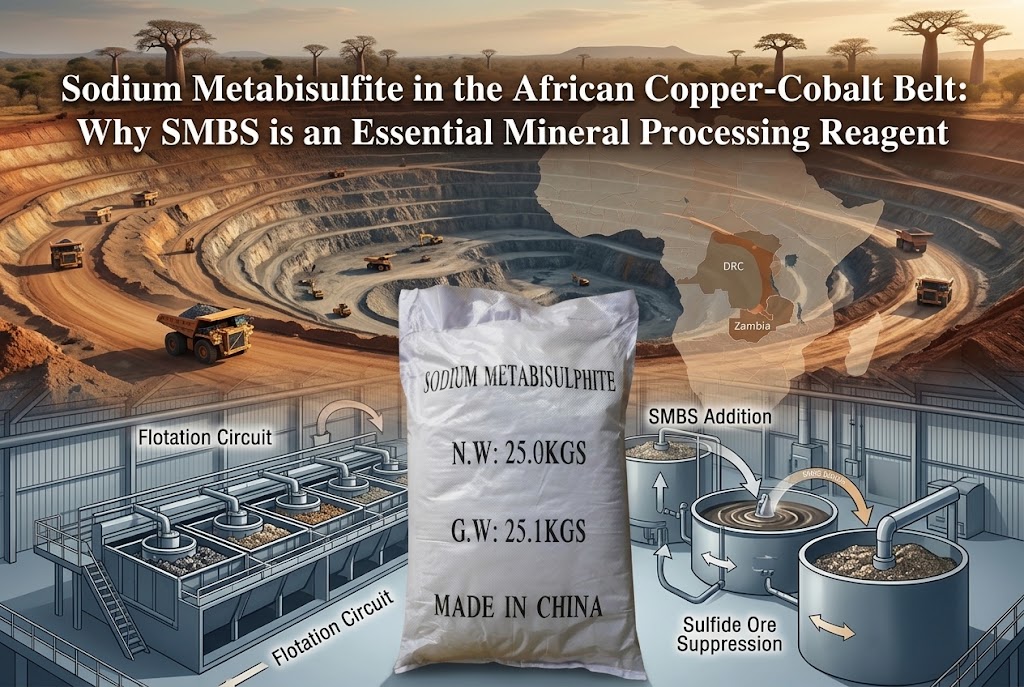
The widespread adoption of sodium metabisulfite for copper cobalt mining stems from its dual metallurgical functions: serving as a pyrite flotation depressant in sulfide ore separation and as an essential reducing agent in acid leaching for cobalt oxide extraction.
This procurement guide analyzes the dual chemical mechanisms of sodium metabisulfite, outlines regional purchasing characteristics across global mining hubs, and provides sourcing criteria for industrial sodium metabisulfite for copper cobalt mining.
1. Why Sodium Metabisulfite Plays a Dual Role in Copper-Cobalt Processing
In copper-cobalt mining, mineral processing and hydrometallurgical circuits often require chemical reagents that can perform multiple functions. Among these reagents, sodium metabisulfite (SMBS), with the chemical formula Na₂S₂O₅, plays an important role in both cobalt extraction and sulfide flotation.
In particular, sodium metabisulfite for copper cobalt mining can function as a reducing agent during acid leaching and as a flotation depressant during sulfide mineral separation. In addition, it can be used in selected effluent treatment processes.
These functions make SMBS an important reagent for copper-cobalt processing plants, especially where operators need to improve cobalt dissolution and control unwanted iron sulfide flotation.
| Process Stage | Chemical Mechanism & Reaction Function |
|---|---|
| Oxide Ore Leaching | Reducing agent: Converts less-soluble Co(III) into more soluble Co(II) |
| Sulfide Flotation | Flotation depressant: Helps inhibit pyrite and unwanted iron sulfide activation |
| Effluent Treatment | Treatment reagent: Can participate in reducing residual oxidizing species and selected wastewater treatment reactions |
Therefore, understanding how SMBS behaves at each stage is essential when designing or optimizing a copper-cobalt processing circuit.
1.1 Cobalt Extraction: SMBS as a Reducing Agent in Acid Leaching
Cobalt in Central African deposits can occur predominantly in oxidized minerals such as heterogenite (CoOOH or Co₂O₃·CuO·H₂O). In these minerals, cobalt can exist in the trivalent oxidation state (Co³⁺).
However, trivalent cobalt generally has relatively low solubility in conventional sulfuric acid leaching solutions. As a result, simply increasing acid consumption may not provide the desired cobalt extraction performance.
This is where sodium metabisulfite for copper cobalt mining can provide an important chemical function.
When sodium metabisulfite enters an acidic leaching environment, it can generate sulfur dioxide (SO₂). The resulting reducing conditions promote the conversion of relatively insoluble Co³⁺ into more soluble divalent cobalt (Co²⁺).
The representative reaction can be expressed as:
As a result, the reduction step can significantly improve cobalt dissolution. Under suitable ore and process conditions, cobalt extraction yields can exceed 90%.
Therefore, SMBS is not simply an auxiliary reagent in this type of circuit. Instead, it can directly influence the efficiency of cobalt recovery by supporting the conversion of cobalt into a more soluble chemical form.
1.2 Copper-Cobalt Flotation: SMBS as a Pyrite Depressant
In addition to hydrometallurgical applications, sodium metabisulfite is also used in copper-cobalt flotation circuits.
Complex sulfide ores may contain valuable minerals such as chalcopyrite (CuFeS₂) and carrollite (CuCo₂S₄) together with unwanted iron sulfides such as pyrite (FeS₂). Consequently, selective flotation is required to separate valuable copper and cobalt minerals from gangue and unwanted sulfides.
SMBS can contribute to this separation through several surface-chemical effects.
- Surface hydrophilicity: When SMBS dissolves in water, it forms bisulfite (HSO₃⁻) and sulfite (SO₃²⁻) species. These species can interact with collector films on mineral surfaces.
- Collector interaction: SMBS can help disrupt or decompose xanthate collector coatings associated with pyrite surfaces.
- Selective depression: By promoting a more hydrophilic pyrite surface, SMBS can reduce the tendency of pyrite to float while allowing targeted copper and cobalt sulfide minerals to remain more floatable.
Consequently, the correct use of SMBS can help improve concentrate selectivity and reduce the amount of unwanted iron sulfide entering valuable copper-cobalt concentrate streams.
2. Regional Procurement Demand: Africa, Southeast Asia and Central Asia
Although SMBS has applications across the global mining industry, procurement requirements vary considerably by region.
In practice, factors such as ore characteristics, processing technology, transportation infrastructure, purchase volume, freight costs, and storage conditions all influence the way mining companies source sodium metabisulfite.
The following comparison summarizes several important mining corridors:
| Global Mining Corridor | Key Sourcing Characteristics | Primary Chemical Demand Profile |
|---|---|---|
| African Copperbelt (DRC / Zambia) | Large-scale bulk procurement of 100–1,000 t+ batches; long sea-land transit requires moisture-resistant packaging | High-purity SMBS for cobalt reduction leaching and copper flotation |
| Southeast Asia (Indonesia / Philippines) | Strong sensitivity to unit price and freight costs; significant nickel laterite and gold processing activity | Moderate-to-bulk SMBS for acid leaching, process treatment and tailings applications |
| Central Asia (Kazakhstan / Uzbekistan) | Procurement is often centralized through state enterprises or major mining groups | Technical-grade reagents with strict overland and rail logistics requirements |
Among these regions, the African Copperbelt is particularly important for copper-cobalt applications.
Large mining operations in the DRC and Zambia may require substantial quantities of mineral processing reagents. Furthermore, long transportation routes make packaging integrity and chemical stability especially important.
Therefore, buyers should evaluate not only the unit price of SMBS but also its purity, packaging configuration, shipping conditions, and storage stability.
3. Quality and Logistics Requirements for African Mining Supply Chains
For remote mining operations, sourcing the correct grade of chemical is only the first step. Because chemical products may travel long distances by sea, road, or rail, quality consistency and packaging performance are equally important.
In particular, African mining supply chains can involve extended transportation periods and exposure to high humidity. Consequently, inadequate packaging can result in moisture absorption, caking, or premature chemical degradation.
3.1 High Active Purity: ≥97% Na₂S₂O₅
For large-scale copper-cobalt processing, buyers commonly prioritize high active purity.
A sodium metabisulfite specification of ≥97% Na₂S₂O₅ provides a high active content and can help reduce the amount of material required for a given process duty.
This can be particularly valuable when supplying landlocked processing facilities in regions such as the DRC and Zambia. Lower material requirements can also help reduce the total tonnage that must be transported.
Therefore, when comparing suppliers, procurement teams should evaluate the actual active content rather than relying solely on the quoted price per metric ton.
3.2 Moisture-Resistant Heavy-Duty Packaging
Packaging is another critical consideration for sodium metabisulfite for copper cobalt mining.
Long maritime transportation followed by inland road haulage can expose chemical cargo to high humidity, temperature changes, and tropical rainfall. If moisture enters the package, SMBS may cake and gradually oxidize into sodium sulfate.
For this reason, suitable packaging can include:
- 25 kg woven polypropylene bags with inner polyethylene liners
- 1,000 kg heavy-duty jumbo bags
- Moisture-resistant outer packaging for extended transportation
- Proper palletization and container loading for long-distance logistics
In other words, packaging should be treated as part of the chemical supply solution rather than as a secondary consideration.
3.3 Consistent Particle Size and Solubility
Particle characteristics also influence the practical performance of sodium metabisulfite.
In high-throughput processing plants, the reagent may need to dissolve rapidly and consistently before being introduced into automated dosing systems or agitation leaching tanks.
Therefore, buyers should evaluate:
- Particle size consistency
- Dissolution behavior
- Water solubility
- Batch-to-batch consistency
- Compatibility with existing dosing equipment
Consistent physical properties can help maintain stable reagent preparation and dosing across continuous processing operations.
4. Why SMBS Matters in Copper-Cobalt Mining
Overall, the value of sodium metabisulfite for copper cobalt mining comes from its ability to support different stages of mineral processing.
In hydrometallurgical circuits, SMBS can act as a reducing agent that promotes the conversion of Co³⁺ to the more soluble Co²⁺ form during acid leaching.
Meanwhile, in sulfide flotation, SMBS can function as a flotation depressant, helping suppress unwanted pyrite and other iron sulfide minerals.
This dual functionality provides several potential process benefits:
- Improved cobalt dissolution
- More effective cobalt recovery
- Better copper-cobalt flotation selectivity
- Reduced pyrite contamination
- More controlled mineral separation
- Greater flexibility in reagent selection
However, actual performance depends on ore mineralogy, pulp chemistry, reagent dosage, pH, temperature, residence time, and the overall process flowsheet. Therefore, reagent selection should always be evaluated against the specific operating conditions of the processing plant.
Technical Summary
The application of sodium metabisulfite for copper cobalt mining is closely associated with its important chemical functions in both hydrometallurgical and mineral flotation processes.
During oxide ore leaching, SMBS can generate reducing conditions that promote the conversion of relatively insoluble Co³⁺ into soluble Co²⁺, supporting cobalt extraction. Under suitable processing conditions, cobalt recovery can exceed 90%.
Meanwhile, during sulfide flotation, SMBS can act as a pyrite flotation depressant, helping control unwanted iron sulfide minerals and improve copper-cobalt concentrate selectivity.
For mining operations in the African Copperbelt and other major mining regions, however, chemical performance is only part of the sourcing equation. Purity, particle size, dissolution performance, moisture-resistant packaging, bulk supply capacity, and logistics reliability are equally important.
By combining consistent technical-grade quality with appropriate packaging and reliable bulk supply, SXS provides sodium metabisulfite, mineral processing reagents, and industrial chemicals for copper-cobalt mining, hydrometallurgy, flotation, and other mineral processing applications.