



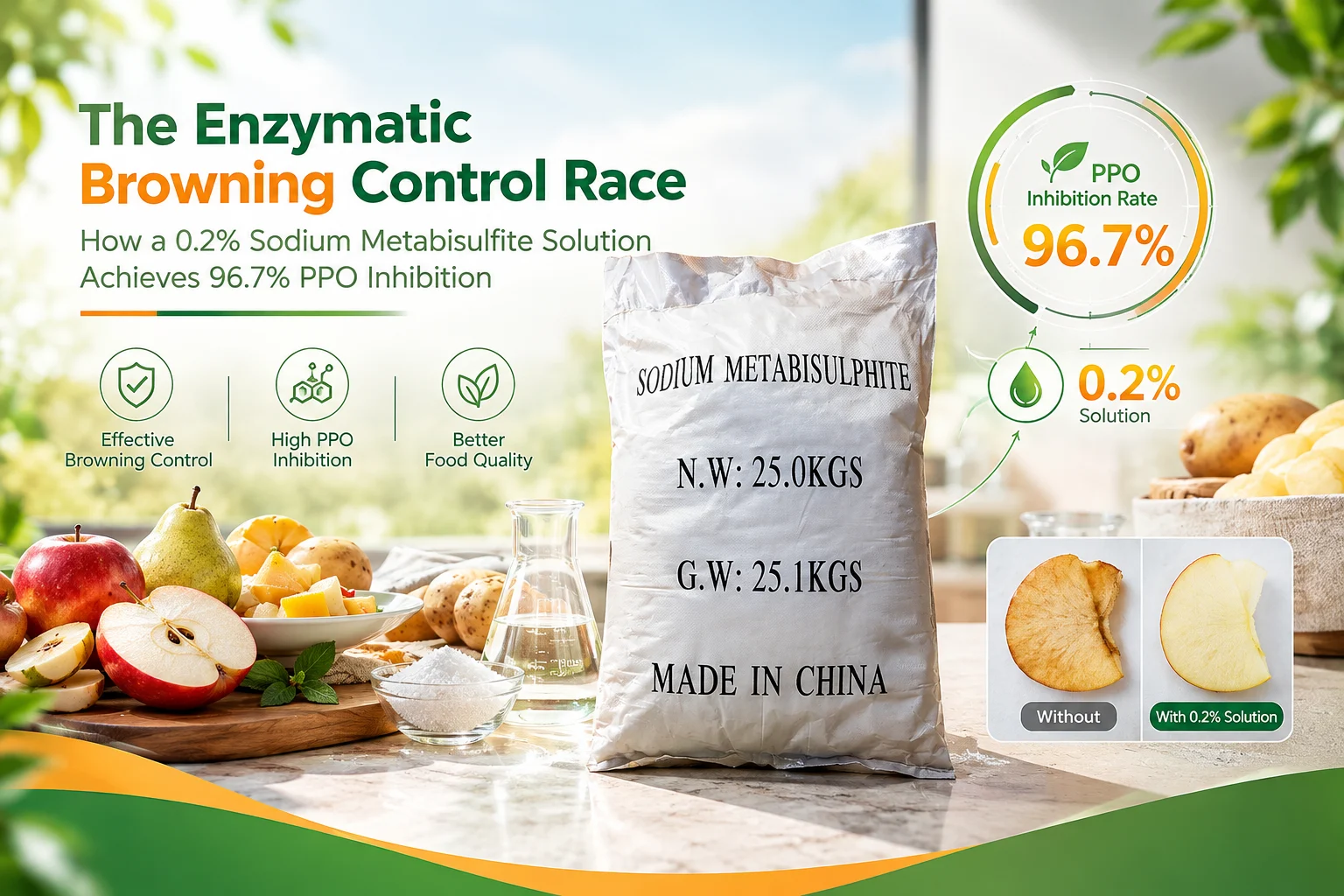
Sodium Metabisulfite Food Grade for Industrial Anti-Browning
Enzymatic browning is a major quality-control challenge for fruit and vegetable processors. When fruits or vegetables are sliced, diced, or crushed, tissue damage exposes polyphenol oxidase (PPO) to oxygen and naturally occurring phenolic compounds. This reaction produces o-quinones, which subsequently form brown pigments and can affect product appearance, flavor, and nutritional quality.
Citric acid and ascorbic acid are widely used as anti-browning agents. However, comparative laboratory results show that food-grade sodium metabisulfite can achieve high PPO inhibition at a substantially lower concentration under specific test conditions.
In reported trials, a 0.2% sodium metabisulfite solution inhibited 96.74% of PPO activity in banana slices and 87.17% in apple slices. These results demonstrate why sulfite-based treatments remain an important option for industrial fruit and vegetable preservation where their use is permitted and properly controlled.
1. Sodium Metabisulfite vs. Citric and Ascorbic Acid for Browning Control
Anti-browning performance depends on both the chemical mechanism and the concentration used. The following results illustrate the difference between sodium metabisulfite and commonly used organic acids.
| Anti-Browning Agent | Test Concentration | Reported PPO Inhibition / Effect | Primary Mechanism |
|---|---|---|---|
| Sodium Metabisulfite | 0.2% | 96.74% in banana; 87.17% in apple | PPO inhibition + quinone reduction |
| Citric Acid | 2.0% | Approx. 59.5% inhibition | Lowers pH and affects PPO activity |
| Ascorbic Acid | 2.0% | Temporary inhibition | Reduces quinones back toward phenolic compounds |
0.2% Sodium Metabisulfite
A 0.2% sodium metabisulfite solution produced the highest reported PPO inhibition among the compared treatments, reaching 96.74% for banana slices and 87.17% for apple slices under the stated laboratory conditions.
Its effectiveness is associated with more than one chemical pathway. Sulfite and bisulfite species can interfere with PPO-mediated oxidation while also reacting with oxidation intermediates.
2.0% Citric Acid
A 2.0% citric acid solution reduced PPO activity by approximately 59.5% in the cited comparison.
Citric acid primarily works by reducing the pH of the treatment environment. Because PPO activity depends strongly on pH, shifting the system away from its favorable operating range can reduce enzymatic activity.
However, the reported test used a concentration ten times higher than the 0.2% sodium metabisulfite treatment.
2.0% Ascorbic Acid
Ascorbic acid provides another anti-browning pathway by reducing o-quinones back toward their corresponding phenolic compounds.
This effect can be effective during the early stages of processing, but its protective capacity decreases as ascorbic acid is consumed through oxidation. If PPO remains active and oxygen is available, browning can resume after the reducing capacity is depleted.
2. How Sodium Metabisulfite Controls Enzymatic Browning
The anti-browning function of food-grade sodium metabisulfite can be understood by following the PPO reaction pathway.
When sodium metabisulfite dissolves in water, it establishes sulfite and bisulfite equilibria and can generate dissolved sulfur dioxide depending on the pH of the solution.
A simplified representation is:
Na2S2O5+H2O→2NaHSO3\mathrm{Na_2S_2O_5 + H_2O \rightarrow 2NaHSO_3}
Under acidic conditions, bisulfite can also participate in equilibrium with dissolved sulfur dioxide:
HSO3−+H+⇌SO2(aq)+H2O\mathrm{HSO_3^- + H^+ \rightleftharpoons SO_2(aq) + H_2O}
These sulfur-containing species contribute to the anti-browning behavior of sulfite treatments.
2.1 Inhibition of PPO-Catalyzed Oxidation
PPO is a copper-containing enzyme responsible for catalyzing the oxidation of phenolic compounds in the presence of oxygen.
Sulfite and bisulfite species can interact with the PPO reaction system and inhibit enzymatic oxidation. This reduces the formation of the reactive quinone intermediates responsible for subsequent pigment formation.
The practical result is slower development of brown discoloration on cut fruit and vegetable surfaces.
2.2 Reaction with o-Quinones
PPO inhibition alone does not fully explain the effectiveness of sulfite treatments.
When o-quinones are already present, bisulfite can react with these highly reactive intermediates and reduce or stabilize them. This interrupts the downstream reactions that would otherwise produce polymerized brown pigments.
The two pathways can therefore be summarized as:
PPO activity ↓ → o-quinone formation ↓
and
o-quinone + bisulfite → browning reaction interrupted
This dual role helps explain the strong anti-browning performance observed in the cited laboratory trials.
3. Why Processing Concentration Matters
One of the most relevant considerations for industrial buyers is the relationship between treatment concentration and processing performance.
The cited comparison found that:
- 0.2% sodium metabisulfite achieved 96.74% PPO inhibition in banana slices.
- 0.2% sodium metabisulfite achieved 87.17% PPO inhibition in apple slices.
- 2.0% citric acid produced approximately 59.5% PPO inhibition.
- Ascorbic acid provided reducing activity but could lose effectiveness as it became oxidized.
This does not mean that a single concentration is universally suitable for every fruit, vegetable, process, or market. PPO activity varies by species, cultivar, maturity, temperature, pH, oxygen exposure, treatment time, and substrate condition.
For commercial production, processors should establish the appropriate concentration and contact time through product-specific validation and applicable food regulations.
4. Quality Requirements for Food-Grade Sodium Metabisulfite
For industrial food processing, chemical performance must be supported by consistent raw-material quality.
When sourcing sodium metabisulfite food grade, procurement teams should evaluate several factors.
High Chemical Purity
A purity level of ≥98% is commonly specified for industrial sodium metabisulfite products. Consistent purity helps provide predictable sulfite availability during solution preparation and processing.
Buyers should verify the actual specification through the supplier’s Certificate of Analysis (COA) rather than relying on a general product description.
Fast and Consistent Solubility
Sodium metabisulfite should dissolve efficiently in process water to support consistent treatment concentrations.
Reliable dissolution is particularly important for dipping, spraying, and other continuous processing systems where uneven solution preparation can produce inconsistent anti-browning results.
5. Sodium Metabisulfite for Fruit and Vegetable Processing
The anti-browning properties of sodium metabisulfite make it relevant to several commercial processing applications, including:
- Apple slices
- Banana processing
- Potato products
- Dried fruits
- Cut fruits and vegetables
- Other products where sulfite treatment is legally permitted
The actual treatment method depends on the product and production line. Common approaches can include immersion or spraying, followed by controlled draining, drying, or subsequent processing.
For B2B buyers, the goal is not simply to select the strongest chemical treatment. The process must balance PPO inhibition, appearance, flavor, residue limits, processing time, and regulatory compliance.
6. Procurement Checklist for Sodium Metabisulfite Food Grade
Before selecting a bulk supplier, food manufacturers can use the following checklist:
| Procurement Factor | What to Verify |
|---|---|
| Grade | Food-grade specification for the target market |
| Purity | ≥98% or agreed purchasing specification |
| COA | Batch-specific analytical results |
| Solubility | Consistent dissolution in process water |
| Impurities | Heavy metals and other relevant parameters |
| Packaging | Suitable for storage and transportation |
| Supply Capacity | Consistent bulk production and delivery |
| Regulatory Support | Documentation for the intended application |
A qualified supplier should be able to provide technical documentation alongside commercial quotations, allowing the buyer’s quality and procurement teams to complete material qualification before production.
7. SXS Sodium Metabisulfite Food Grade for B2B Food Processing
SXS supplies sodium metabisulfite food grade for industrial food-processing applications, including fruit and vegetable preservation where sulfite treatment is permitted.
For B2B customers, SXS can provide product specifications, Certificate of Analysis (COA) documentation, and bulk quotation support to help processors evaluate material quality and establish consistent supply.
When selecting an anti-browning ingredient, manufacturers should consider more than the headline inhibition rate. Material purity, application concentration, processing conditions, regulatory limits, and batch consistency all influence the final result.
Contact SXS to request food-grade sodium metabisulfite solution specifications, COA documents, samples, and bulk B2B pricing for your food-processing requirements.