


Food beverage processors, pharmaceutical chemical buyers, and industrial procurement managers are increasingly re-evaluating their preservative and antioxidant supply chains. A key question facing supply chain executives is: “What key demand drivers are shaping the food-grade sodium metabisulfite market through 2032, and how do regional compliance standards impact global sourcing?”
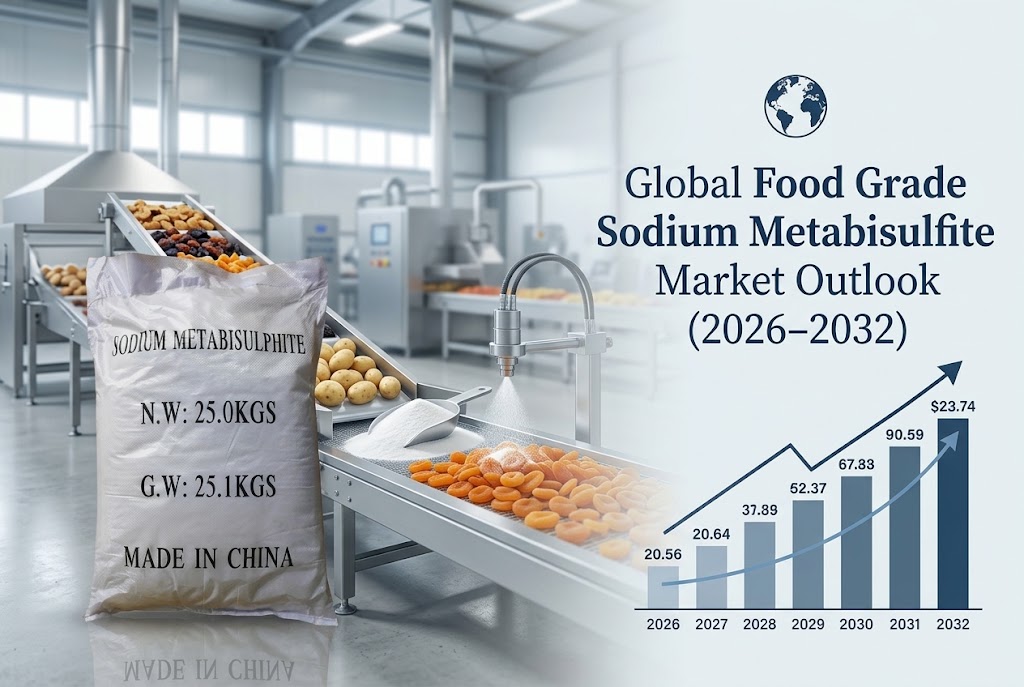
The global food-grade sodium metabisulfite market was valued at approximately USD 320 million in 2025 and is projected to expand at a Compound Annual Growth Rate (CAGR) of 4.8%, reaching USD 442 million by 2032. This expansion is primarily driven by rigorous shelf-life requirements in processed foods, expanding water treatment protocols, and stabilizing demands within pharmaceutical formulations.
Understanding global demand shifts, regional regulatory nuances, and material purity requirements enables chemical buyers to secure reliable supply lines. This technical report examines core market drivers, regional dynamics, and technical evaluation criteria for sourcing food-grade sodium metabisulfite.
1. Market Valuation & Core Growth Vectors (2026–2032)
Growth across food grade sodium metabisulfite applications spans three primary end-use sectors:
+-----------------------------------------------------------------------------------------+
|                  Global Market Outlook: Food Grade Sodium Metabisulfite                 |
+---------------------+-------------------------------------------------------------------+
| Market Metric       | Baseline (2025)             | Forecast Projection (2032)          |
+---------------------+-------------------------------------------------------------------+
| Market Revenue      | ~ USD 320 Million           | ~ USD 442 Million                   |
| Forecast CAGR       | 4.8% (2026–2032)                                                  |
| Core End-Uses       | Food & Beverage, Water Treatment, Pharmaceutical Formulations     |
| Key Regions         | Asia-Pacific (Dominant Volume), North America & Europe (High Pure)|
+---------------------+-------------------------------------------------------------------+
1. Food & Beverage Preservation
As processed food trade expands globally, inhibiting enzymatic browning and microbial spoilage remains a critical operational mandate. Sodium metabisulfite acts as a potent antioxidant, bleaching agent, and antimicrobial preservative in fruit wines, glucose syrups, starch processing, and preserved vegetables (such as bamboo shoots and mushrooms).
2. Membrane Water Treatment & Dechlorination
In food processing and beverage manufacturing plants, process water purity is vital. Sodium metabisulfite serves as an effective reducing agent to neutralize free chlorine and protect delicate reverse osmosis (RO) membranes from oxidative degradation.
3. Pharmaceutical & Chemical Synthesis
Within pharmaceutical manufacturing, food/pharma grade sodium metabisulfite acts as a stabilizing antioxidant in parenteral formulations, oral liquids, and topical creams, protecting active pharmaceutical ingredients (APIs) from oxidation.
2. Regional Market Dynamics: North America, Europe, and Asia-Pacific
Regional adoption trajectories vary based on industrial output, regulatory frameworks, and food manufacturing expansion:
| Regional Market | Strategic Drivers & Regulatory Focus | Market Characterization |
| Asia-Pacific (APAC) | Rapid expansion in food processing, agricultural exporting, and beverage bottling. High consumption in starch, sugar, and wine industries. | Largest volume consumption market; high growth in China, India, and Southeast Asia. |
| North America | Stringent FDA compliance, advanced beverage/winemaking sectors, and high demand for purified water treatment chemicals. | High-value market prioritizing strict purity, low heavy metal content, and ISO certification. |
| Europe | Robust EFSA food additive regulations (E223 compliance), growing organic winemaking, and pharmaceutical manufacturing demands. | Quality-driven market focusing on REACH compliance, allergen labeling, and tight trace-purity limits. |
3. Chemical Performance & Functional Advantages of SXS Sodium Metabisulfite
SXS supplies high-purity food-grade sodium metabisulfite engineered to satisfy international food safety and pharmaceutical standards:
1. Chemical Purity and Dissolution Profile
Appearing as a white to off-white crystalline powder, SXS sodium metabisulfite delivers high purity and consistent batch-to-batch stability. Its superior water solubility enables rapid preparation of concentrated aqueous solutions without residual sediment.
2. Potent Antioxidant and Reducing Capabilities
Upon dissolution, sodium metabisulfite releases active sulfur dioxide (SO_2), establishing a protective reducing environment that scavenges dissolved oxygen, inhibits polyphenol oxidase (PPO), and halts enzymatic browning in fresh produce and juices.
3. Multi-Industry Functional Applications
-
Winemaking & Beverage Fermentation: Controls wild yeast and spoilage bacteria while preventing oxidative color change and flavor degradation in fruit wines.
-
Starch & Sugar Refining: Acts as an efficient bleaching agent and antioxidant during corn wet-milling, glucose processing, and sugar crystallization.
-
Vegetable & Food Processing: Preserves original color, texture, and crispness in processed mushrooms, bamboo shoots, dehydrated potatoes, and dried fruits.
4. Procurement Sourcing Protocol: Evaluating Sodium Metabisulfite Quality
Procurement teams sourcing sodium metabisulfite should apply the following evaluation criteria:
-
Verify Grade Certifications & Purity Standards: Ensure the chemical batch meets Food Chemicals Codex (FCC), E223, or USP grade parameters with strict limits on heavy metals (Pb ≤ 10 ppm, As ≤ 2 ppm).
-
Evaluate Moisture Control & Storage Packaging: High-purity sodium metabisulfite is hygroscopic and prone to premature sulfur dioxide off-gassing if exposed to ambient moisture. Confirm supplier packaging includes moisture-barrier PE liners within multi-ply paper bags or bulk sacks.
-
Assess Supply Chain Traceability: Partner with suppliers that provide full batch trace-analysis, consistent particle sizing for uniform dissolution rates, and REACH/ISO documentation for global customs clearance.
Technical Summary
Projected to expand from USD 320 million in 2025 to USD 442 million by 2032 (4.8% CAGR), global demand for food-grade sodium metabisulfite is anchored by rising food safety standards, expanding beverage production, and water purification needs. Achieving optimal preservation results requires selecting high-purity, fast-dissolving chemical grades that comply with regional regulatory standards. SXS specializes in manufacturing high-purity, ultra-stable sodium metabisulfite solutions tailored for global food processors, pharmaceutical manufacturers, and industrial operations.