



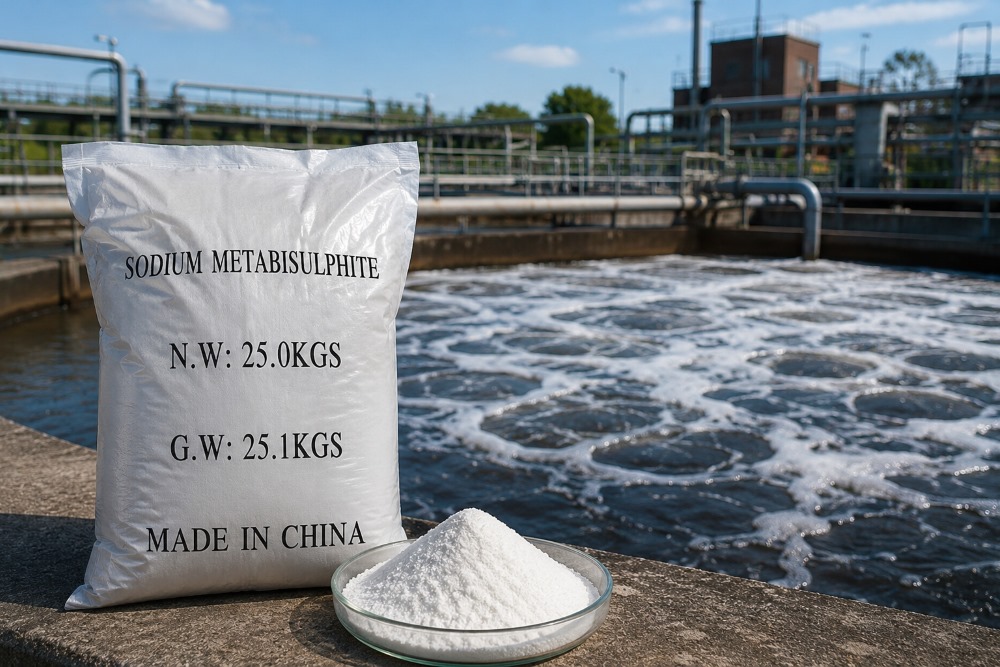
Water treatment engineers, municipal utility operators, and industrial water quality managers frequently face complex chemical balancing requirements when neutralizing residual disinfectants. While traditional free chlorine easily dissipates through aeration or standard bisulfite dosing, municipal facilities increasingly utilize chloramines (monochloramine, NH2Cl) for long-lasting distribution system disinfection. Consequently, water plant engineers frequently ask technical chemical suppliers a crucial operational question: “Can sodium metabisulfite effectively remove chloramines during municipal water purification? How does the reaction stoichiometry differ from free chlorine neutralization, and what exact dosing calculations protect downstream filtration membranes and dialysis systems?”
Leaving unneutralized chloramines in municipal distribution networks or industrial process lines creates severe compliance and health risks. Chloramine residuals cause hemolysis in kidney dialysis patients, corrode copper and lead piping joints, and oxidize sensitive reverse osmosis (RO) membranes in water recycling plants. Utilizing high-purity chemical reagents for water purification with sodium pyrosulfite (commonly known in industrial chemistry as sodium metabisulfite, Na2S2O5) provides a rapid, cost-effective method for complete dechlorination and chloramine quenching. This technical guide outlines the reaction pathways of inorganic reducers, contrasts free chlorine vs. chloramine kinetics, and details precise engineering dosing protocols for municipal facilities.
1. Chemical Reaction Mechanisms: Neutralizing Chloramines vs. Free Chlorine
When sodium pyrosulfite (Na₂S₂O₅) dissolves in water, it undergoes hydrolysis and forms sodium ions (Na⁺) and bisulfite ions (HSO₃⁻). The generated bisulfite ions then react with free chlorine and chloramine to remove residual disinfectants from water.
| Reaction Stage | Chemical Reaction | Function |
|---|---|---|
| Step 1: Dissolution | Na₂S₂O₅ + H₂O → 2Na⁺ + 2HSO₃⁻ | Produces bisulfite ions in aqueous solution. |
| Step 2: Free Chlorine Removal | HSO₃⁻ + HOCl → SO₄²⁻ + Cl⁻ + 2H⁺ | Neutralizes free chlorine rapidly. |
| Step 3: Chloramine Removal | HSO₃⁻ + NH₂Cl + H₂O → SO₄²⁻ + Cl⁻ + NH₄⁺ + H⁺ | Reduces monochloramine through a slower reaction. |
These reactions explain why sodium pyrosulfite is widely used as a dechlorinating agent in water treatment, food processing, and industrial applications.
Hydrolysis and Bisulfite Formation
When sodium pyrosulfite (Na₂S₂O₅) dissolves in water, it quickly undergoes hydrolysis. The reaction produces sodium ions (Na⁺) and bisulfite ions (HSO₃⁻), which act as the active reducing agent during water treatment.
Chemical Reaction
Na₂S₂O₅ + H₂O → 2Na⁺ + 2HSO₃⁻
The generated bisulfite ions donate electrons to reduce oxidizing compounds and support effective dechlorination.
Free Chlorine Neutralization
Bisulfite reacts rapidly with free chlorine, including hypochlorous acid (HOCl) and hypochlorite (OCl⁻). As a result, free chlorine converts into harmless chloride ions, while bisulfite oxidizes into sulfate.
Chemical Reaction
HSO₃⁻ + HOCl → SO₄²⁻ + Cl⁻ + 2H⁺
This reaction occurs within seconds under normal treatment conditions. Therefore, sodium pyrosulfite is widely used for rapid free chlorine removal in industrial and municipal water systems.
Monochloramine Neutralization
Bisulfite also reacts with monochloramine (NH₂Cl), although the reaction proceeds more slowly than free chlorine removal. During the reaction, the nitrogen-chlorine bond breaks, converting monochloramine into sulfate, chloride, and ammonium ions.
Chemical Reaction
HSO₃⁻ + NH₂Cl + H₂O → SO₄²⁻ + Cl⁻ + NH₄⁺ + H⁺
Because monochloramine has a lower oxidation potential than free chlorine, it requires longer contact time and adequate mixing. Proper reaction conditions help achieve efficient chloramine removal and stable water treatment performance.
2. Health Risks, Piping Corrosion, and RO Membrane Safeguards
Precise residual chlorine neutralization serves as a non-negotiable protection layer across medical, municipal, and industrial infrastructure:
[Chloramine Residuals in Water]
  |--> Dialysis Units   ---> Hemolysis risk (Chloramines cross membranes into bloodstream)
  |--> RO Desalination  ---> Oxidative degradation of polyamide thin-film composite membranes
  |--> Piping Networks  ---> Accelerated pitting corrosion and lead/copper leaching
-
Dialysis Safety Standards: Chloramine contamination in medical feed water represents an acute hazard for kidney dialysis patients. Chloramines easily penetrate dialysis membranes, causing red blood cell destruction (hemolysis) and methemoglobinemia. Consequently, medical-grade water preparation demands complete chemical dechlorination using high-purity sodium pyrosulfite.
-
Corrosion Control in Utility Infrastructure: Persistent chloramine residuals accelerate pitting corrosion in copper plumbing and degrade elastomer seals across municipal distribution networks.
-
Polyamide Membrane Protection: Modern desalination and wastewater recycling plants rely on polyamide thin-film composite reverse osmosis (RO) membranes. Exposing these membranes to persistent oxidants like chloramines breaks down the polymer matrix, degrading salt rejection performance and causing permanent membrane failure.
3. Engineering Dosing Calculations and Operational Ratios
Accurate sodium metabisulfite dechlorination relies on exact stoichiometric ratios combined with practical safety margins to account for water temperature and organic load fluctuations.
Stoichiometric Demand
| Water Treatment Target | Sodium Metabisulfite Dosage |
|---|---|
| Neutralize 1.0 mg of free chlorine (Cl₂) | 1.34 mg sodium metabisulfite |
| Neutralize 1.0 mg of monochloramine (NH₂Cl) | 1.48–1.80 mg sodium metabisulfite |
Municipal Field Dosing Guidelines
In practical municipal water recycling systems and industrial pre-treatment lines, plant managers apply a 2.0 to 3.0 times safety multiplier over the theoretical minimum. For typical municipal effluent containing residual disinfectants, dosing sodium pyrosulfite within the 5.0 mg/L to 10.0 mg/L range ensures complete oxidation-reduction potential (ORP) control, successfully driving residual oxidant levels to zero before entering sensitive filtration stages.
Chemical Dechlorination Technical Comparison
| Parameter | Free Chlorine (HOCl/OCl⁻) | Monochloramine (NH₂Cl) |
|---|---|---|
| Oxidation Potential | 1.48 V (High) | 0.75 V (Moderate) |
| Reaction Speed with Bisulfite | Less than 3 seconds | Approximately 30–120 seconds |
| Theoretical Sodium Metabisulfite Requirement | 1.34 mg Na₂S₂O₅ per 1 mg Cl₂ | 1.48 mg Na₂S₂O₅ per 1 mg NH₂Cl |
| Recommended Treatment Dosage | 2.0–3.0 mg/L | 5.0–10.0 mg/L |
| Primary Reaction Products | Sulfate (SO₄²⁻), Chloride (Cl⁻), Hydrogen Ions (H⁺) | Sulfate (SO₄²⁻), Chloride (Cl⁻), Ammonium (NH₄⁺), Hydrogen Ions (H⁺) |
4. Operational Best Practices for Plant Engineers
Water quality engineers can optimize chemical feed systems and protect process infrastructure by following three critical guidelines:
-
Monitor ORP and Dissolved Oxygen Continuously: Install online Oxidation-Reduction Potential (ORP) sensors downstream of the chemical injection point to confirm complete residual removal. Because excess sodium pyrosulfite scavenges dissolved oxygen, avoid heavy overdosing (> 15 mg/L) before discharge into open aquatic environments.
-
Ensure Adequate Inline Mixing: Inject sodium pyrosulfite solutions upstream of a static mixer or inside turbulent pipe zones to guarantee rapid contact between bisulfite ions and chloramines.
-
Maintain Solution Freshness: Dry sodium pyrosulfite powder remains stable during long-term storage in sealed bags. However, once dissolved in water feed tanks, liquid bisulfite solutions oxidize naturally when exposed to air. Prepare fresh liquid feed batches every 3 to 7 days to maintain constant chemical strength.
Conclusion: Achieve Absolute Disinfectant Neutralization in Water Treatment
Effective water dechlorination depends on understanding how sodium metabisulfite reacts with free chlorine and chloramines. Proper chemical dosing and high-purity raw materials help improve treatment efficiency while supporting stable system performance.
Using high-quality sodium metabisulfite powder promotes fast dissolution and reliable chlorine removal. As a result, it helps protect membrane filtration systems, reduce oxidation risks, and support water treatment compliance. In addition, consistent product quality improves dosing accuracy across different industrial applications.
As a professional sodium metabisulfite manufacturer, we supply food-grade and industrial-grade products with consistent purity and excellent solubility. Contact our technical team to request product specifications, safety data sheets, application support, or bulk wholesale quotations for your water treatment projects.