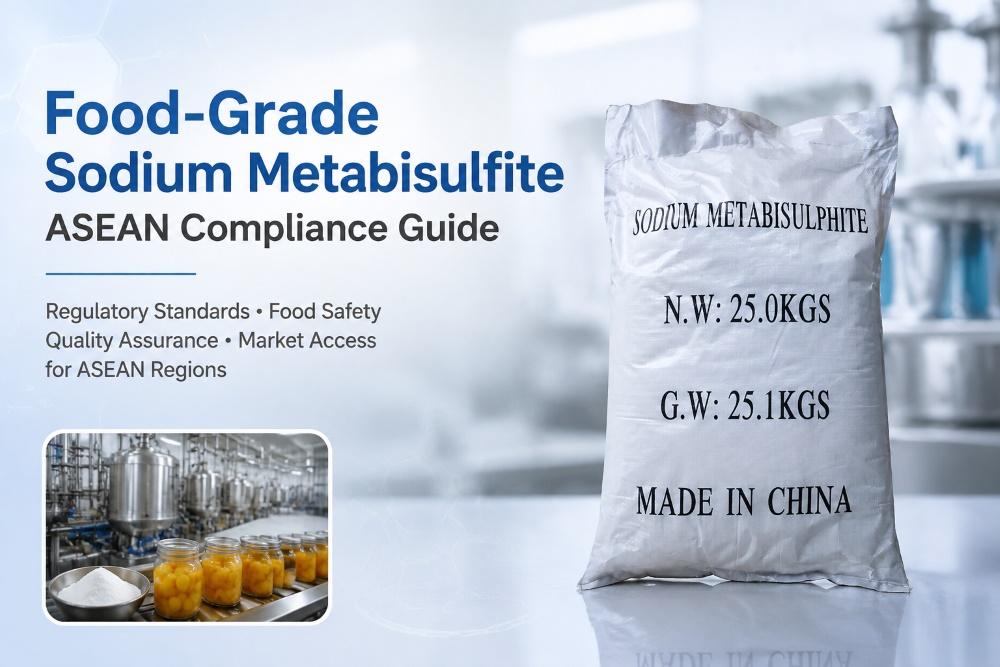



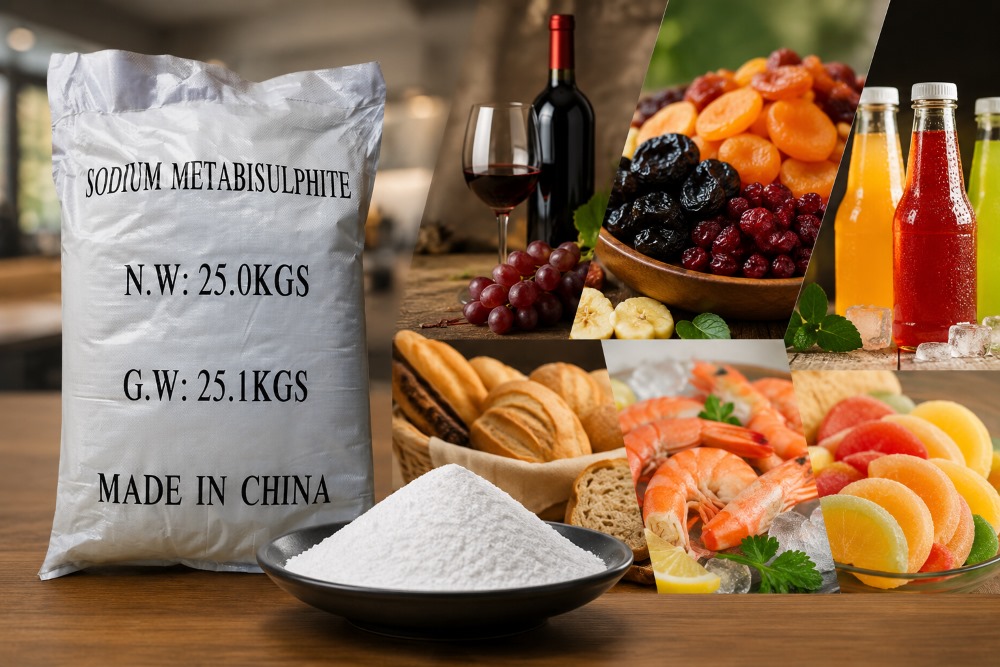
Food safety compliance managers, industrial food processors, and quality assurance inspectors must maintain complete clarity over chemical additive limits before formulating commercial recipes. Because global regulatory bodies enforce strict limits on sulfiting agents, choosing the correct preservation strategy requires precise chemical knowledge. Specifically, miscalculating raw chemical doses or failing to monitor sulphur dioxide (SO2) gas levels can lead to failed import inspections and product recalls at the border.
Deploying premium food-grade sodium metabisulfite allows food manufacturers to protect their products from microbial spoilage and enzymatic browning effectively. This technical sourcing guide details the chemical preservation mechanisms, specific category maximum dosage limits, and practical application examples for modern food production lines.
1. The Chemical Preservation Mechanism: How Sulfiting Agents Protect Food
To apply this inorganic salt effectively in a factory environment, your production team must first understand how it functions chemically when mixed into food matrices.
Sodium Metabisulfite + H2O ──> Free Sulphur Dioxide (SO2) ──> Formed Sulphurous Acid (H2SO3) ──> ♻️ Inhibits Oxidizing Enzymes
Within the food processing industry, technicians utilize food-grade sodium metabisulfite as a multi-functional bleaching agent, antimicrobial preservative, and antioxidant. When this crystalline powder dissolves in a water-based food matrix, it rapidly releases free sulphur dioxide gas (SO2).
Subsequently, this gas reacts with the surrounding moisture to form active sulphurous acid (H2SO3). This compound acts as a powerful reducing agent that binds directly to organic molecules. By actively disrupting active cell membranes and neutralizing natural polyphenol oxidase enzymes, this reaction completely halts microbial growth and prevents unsightly brown discoloration across raw food tissues.
2. Category Usage Guidelines and Maximum SO2 Residual Limits
Regulatory frameworks do not limit the initial amount of chemical you add to a mixing tank; instead, they regulate the final amount of sulphur dioxide residue left behind in the packaged product.
Sulphur Dioxide Residual Regulatory Limits (GB 2760):
Edible Starches / Fresh Fruits: Ultra-low limits (0.03 - 0.05 g/kg)
Preserved Sweet Fruits & Wines: Higher permitted ceilings (0.25 - 0.40)
According to strict international food safety standards (such as GB 2760-2024), industrial processors must keep final SO2 residues below specific limits. The following table details the maximum allowed concentrations for common food categories:
Sulphur Dioxide Residual Limits by Food Category
| Permitted Food Category | Maximum SO2 Residual Limit | Core Functional Objective |
| Edible Starches | 0.03 g/kg | Inhibits sour fermentation |
| Surface-Treated Fresh Fruits | 0.05 g/kg | Blocks skin oxidation |
| Dried Fruits & Fruit Jams | 0.10 g/kg | Preserves natural color tones |
| Pickled Vegetables | 0.10 g/kg | Controls wild yeast spoilage |
| Biscuits & Baked Goods | 0.10 g/kg | Relaxes the gluten in the dough sheets |
| Dried Dehydrated Vegetables | 0.20 g/kg | Prevents storage browning |
| Standard Grape Wines | 0.25g/L | Prevents bacterial souring |
| Preserved Fruits (Dried/Sweet) | 0.35 g/kg | Extends commercial shelf life |
| Sweet-Type Grape Wines | 0.40g/L | Controls unfermented sugars |
As a general rule, factories cannot use food-grade sodium metabisulfite in standard canned food lines. However, specialized processes (such as color preservation for canned yams) can utilize the chemical safely. To do this, the factory must wash the raw yam slices thoroughly with fresh water before sealing the cans, keeping final residues safely within legal limits.
3. Application Case Study: Discoloration Prevention in Rice Cakes (Niangao)
Reviewing a practical food factory formulation shows how this additive improves visual quality and structural shelf life under high-temperature sterilization.
Rice Flour Base + [Metabisulfite & Citric Acid Blend] ──> Retains High Whiteness (64-68 HW) ──> ♻️ 12-Month Stability
When manufacturers process industrial rice cakes (Niangao), high-temperature retort sterilization (115℃ for 100 minutes) frequently scorches the starches, turning the dough dull and grey. To prevent this, factories mix food-grade sodium metabisulfite with pure citric acid at a ratio ranging from 5:1 to 15:1.
Next, production teams add this blended powder directly into the rice flour at a precise dose of 0.2% to 0.28% of total rice weight. This additive blend keeps the Hunter Whiteness value (HW) consistently high at 64 to 68, whereas untreated rice cakes drop down below a dull 56 HW. Furthermore, this anti-browning method completely blocks starch breakdown, successfully extending the product’s stable retail shelf life out past twelve full months.
Conclusion: Secure Your Food Formulation Compliance
In conclusion, scaling a successful international food brand requires sourcing high-purity ingredients that satisfy demanding food safety compliance checks.
Stop risking your development capital and retail brand reputation on low-tier, industrial-grade chemical salts that introduce unwanted heavy metals into your food production lines. Upgrading your bulk ingredient inventory to our certified food-grade sodium metabisulfite crystals guarantees absolute batch purity, predictable SO2 gas release rates, and excellent color protection. We manufacture every single batch to meet strict food safety standards, helping your products pass international customs audits cleanly.
Contact our chemical engineering sales division today to review our batch analysis sheets and secure your next wholesale shipping container order.