


Mining engineers, mineral processing managers, and metallurgical procurement specialists continuously face stricter environmental regulations alongside declining ore grades. As regulatory agencies impose tight restrictions on toxic chemical reagents in froth flotation circuits, processing plants must adopt safer, highly effective depressants. Consequently, mining operations frequently ask chemical suppliers a strategic question: “How will the application of sodium pyrosulfite in mineral processing evolve over the coming decade, and will tightening global environmental standards restrict or accelerate its adoption in flotation circuits?”
Relying on traditional cyanidation practices or outdated chemical formulations creates severe environmental compliance risks and operational bottlenecks for modern mining operations. Highly toxic depressants face growing regulatory bans, high disposal costs, and public opposition. In contrast, sodium pyrosulfite (sodium metabisulfite) serves as a low-toxicity, versatile depressant for pyrite, sphalerite, and arsenopyrite, making it a critical driver of sustainable mineral processing. This comprehensive technical guide explores how environmental trends shape flotation chemistry, details advanced customized reagent combinations, and outlines strategic procurement practices for mining operations.
1. Why Mining Operations Are Replacing Cyanide Depressants
Environmental regulations continue to restrict the use of cyanide in mineral processing. Many mining operations now seek safer flotation reagents that reduce environmental risks while maintaining mineral recovery. As a result, sodium pyrosulfite has become an increasingly common depressant for copper, lead, and zinc flotation circuits.
Cyanide-Free Flotation Transition
| Industry Driver | Operational Impact |
|---|---|
| Environmental regulations | Restrict cyanide transport, storage, and tailings discharge. |
| Low-toxicity reagents | Sodium pyrosulfite provides a safer flotation alternative. |
| Selective mineral depression | Suppresses pyrite, sphalerite, and arsenopyrite during flotation. |
| Environmental compliance | Helps reduce wastewater treatment requirements and supports regulatory compliance. |
Why Cyanide Is Being Phased Out
Traditional flotation plants commonly use cyanide to suppress iron sulfides during mineral separation. However, stricter environmental regulations have increased compliance costs and limited cyanide use in many mining regions.
How Sodium Pyrosulfite Works
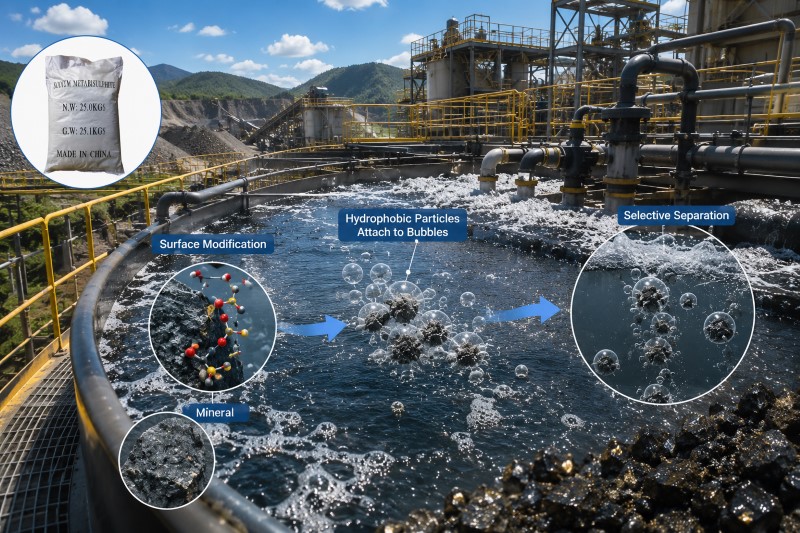
When dissolved in flotation slurry, sodium pyrosulfite produces bisulfite (HSO₃⁻) and sulfite (SO₃²⁻) ions. These ions reduce oxidation-reduction potential (ORP) and weaken xanthate collector films on sulfide minerals. As a result, pyrite and other unwanted sulfides are selectively depressed without using cyanide.
2. Optimizing Flotation Performance with Reagent Blends
Modern ore bodies often contain complex mineral compositions. Therefore, flotation plants frequently combine sodium pyrosulfite with other inorganic reagents to improve selectivity.
Common Reagent Combinations
| Reagent | Primary Function |
|---|---|
| Sodium sulfide (Na₂S) | Improves sulfide mineral depression. |
| Sodium sulfite (Na₂SO₃) | Supports oxidation control during flotation. |
| Sodium carbonate (Na₂CO₃) | Stabilizes slurry pH and flotation conditions. |
| Sodium silicate (Na₂SiO₃) | Disperses clay minerals and suppresses gangue. |
| Aluminum sulfate | Improves selectivity for complex ores. |
| TETA | Enhances copper-nickel flotation performance. |
For example, combining sodium pyrosulfite with sodium carbonate helps stabilize slurry pH while maintaining suitable pulp potential (Eh). This combination improves flotation stability and supports higher recovery of valuable minerals.
3. Sodium Pyrosulfite vs. Cyanide Depressants
| Parameter | Cyanide Depressants | Sodium Pyrosulfite |
|---|---|---|
| Environmental impact | High toxicity | Low toxicity |
| Regulatory compliance | Increasingly restricted | Widely accepted |
| Target minerals | Pyrite, chalcopyrite, sphalerite | Pyrite and arsenopyrite |
| Reagent compatibility | Limited | Compatible with multiple flotation reagents |
| Tailings treatment | Higher treatment costs | Lower treatment requirements |
4. Procurement Considerations for Mining Companies
Mining companies should evaluate several factors before purchasing flotation reagents.
Product Purity
Select sodium pyrosulfite with a purity of at least 97% to maintain consistent flotation performance.
Dissolution Performance
Fine powder or small granular grades dissolve more quickly and improve dosing consistency.
Technical Support
Choose suppliers that provide customized reagent formulations, technical guidance, and packaging options for different ore types.
Conclusion
Sodium pyrosulfite has become an important reagent for modern cyanide-free flotation processes. It helps mining companies improve environmental compliance while maintaining selective mineral separation. In addition, it works well with other flotation reagents, making it suitable for complex ore processing.
When selecting sodium pyrosulfite, buyers should evaluate product purity, dissolution characteristics, and supplier technical support. Choosing the right reagent can improve flotation efficiency, reduce operating costs, and support long-term process stability.
If you are evaluating flotation reagents for copper, lead, zinc, or polymetallic ore processing, contact our technical team for product specifications, application guidance, and laboratory sample support.