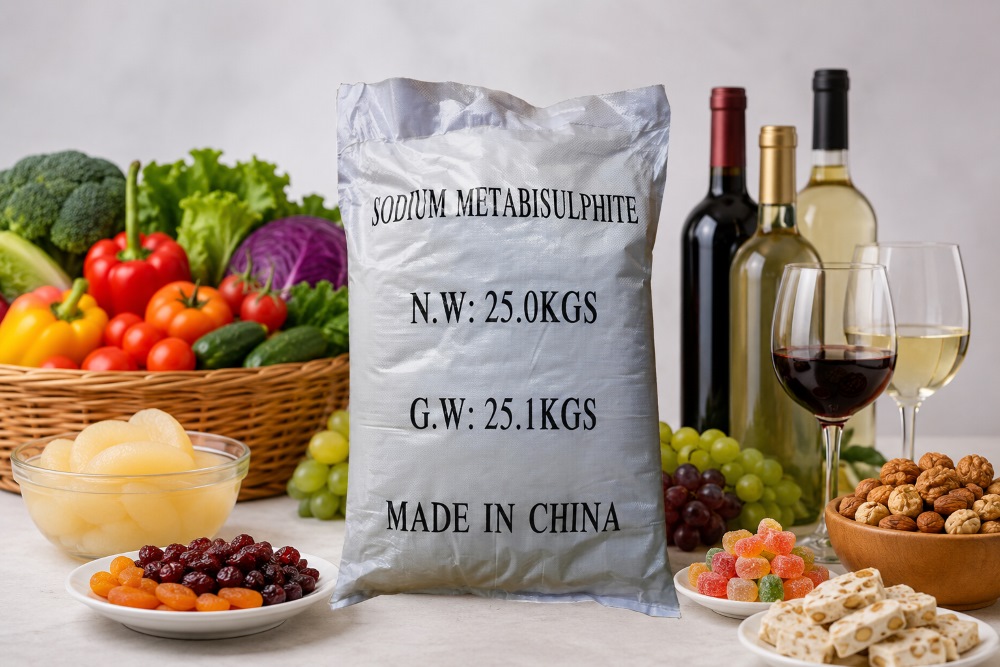



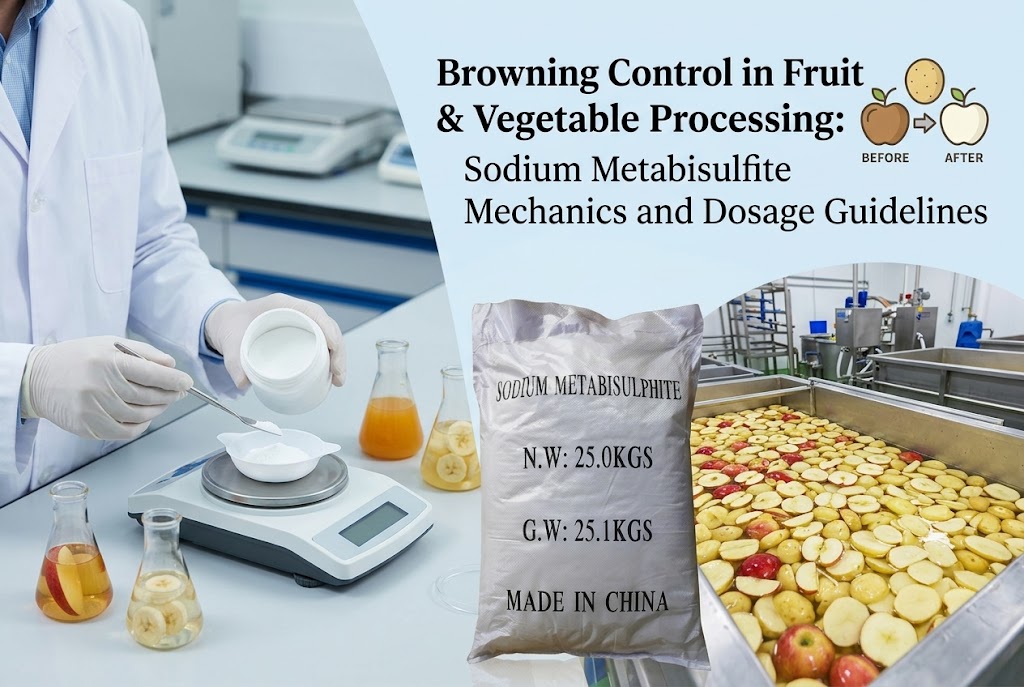
Preventing rapid enzymatic browning during peeling, slicing, and thermal processing remains a critical quality challenge for fruit and vegetable processors. Unprotected cut surfaces on yams, apples, potatoes, and mushrooms oxidize rapidly upon exposure to air, resulting in dark discoloration, off-flavors, and reduced consumer appeal.
To maintain visual freshness and structural integrity, food manufacturers rely on Sodium Metabisulfite (Na2S2O5), a highly effective antioxidant, reducing agent, and antimicrobial preservative. When hydrolyzed in water to release active bisulfite ions and sulfur dioxide (SO2), it suppresses polyphenol oxidase (PPO) activity and scavenges dissolved oxygen.
This technical guide examines the chemical mechanisms of browning inhibition, evaluates empirical trial data, compares alternative color preservatives, and outlines regulatory dosage controls for applying Sodium Metabisulfite in commercial food processing.
1. Chemical Mechanism of Sodium Metabisulfite Anti-Browning Action
When sodium metabisulfite dissolves in water, it quickly hydrolyzes into bisulfite ions:
Na₂S₂O₅ + H₂O → 2NaHSO₃
The generated bisulfite (HSO₃⁻) and sulfite (SO₃²⁻) ions control enzymatic browning through multiple mechanisms.
| Processing Stage | Chemical Reaction and Function |
|---|---|
| Natural Browning Reaction | Phenolic compounds + Oxygen → Quinones → Brown Melanin Pigments |
| Sodium Metabisulfite Dissolution | Na₂S₂O₅ + H₂O → Bisulfite Ions (HSO₃⁻) |
| Enzyme Control | Bisulfite interacts with PPO and reduces enzyme activity |
| Color Protection | Sulfite reduces quinones back into colorless phenolic compounds |
Dual Protection Mechanism of Sodium Metabisulfite
1. Polyphenol Oxidase (PPO) Inhibition
Bisulfite ions interact with the copper-containing active center of PPO enzymes. This interaction reduces enzyme activity and slows down the oxidation process responsible for food discoloration.
2. Quinone Reduction
During oxidation, PPO converts phenolic compounds into reactive quinones. Sodium metabisulfite reduces these quinones back into their original colorless form, preventing further polymerization into brown pigments.
3. Oxygen Scavenging and Microbial Control
Sulfite compounds consume dissolved oxygen in processing solutions. This reduces oxidative reactions and also helps create conditions that limit microbial growth.
Therefore, sodium metabisulfite provides both color preservation and processing stability for commercial food applications.
2. Sodium Metabisulfite Performance in Food Color Preservation Tests
To evaluate the effectiveness of sodium metabisulfite in maintaining food appearance, comparative preservation tests were performed on sliced Chinese yam (Dioscorea polystachya).
The samples were treated before blanching, canning, and retort sterilization at:
- Temperature: 121°C
- Sterilization Time: 15 minutes
- Storage Condition: 37°C accelerated aging test
Two treatment groups were compared:
| Sample Group | Treatment Method |
|---|---|
| Group A | 0.05% Food-Grade Sodium Metabisulfite Solution |
| Group B | 0.05% D-Sodium Isoascorbate Solution |
Color Preservation Results
| Evaluation Item | Sodium Metabisulfite Treatment | Isoascorbate Treatment |
|---|---|---|
| Initial Appearance | Bright white and uniform color | Slight cream color |
| After 15 Days at 37°C | Maintained high brightness (L* > 88) | Minor edge discoloration |
| After 30 Days at 37°C | Excellent color stability | Visible pink-brown discoloration |
| Commercial Quality | Suitable for premium food processing | Increased risk of appearance degradation |
Test Conclusion
Compared with organic antioxidants such as D-sodium isoascorbate, sodium metabisulfite provides stronger thermal stability during high-temperature food processing.
Its reducing ability remains effective during:
- Canning operations
- Retort sterilization
- Long-term storage
- Dehydration processes
This makes sodium metabisulfite a preferred choice for manufacturers requiring consistent product color and extended shelf stability.
3. Sodium Metabisulfite vs Other Anti-Browning Agents
Food processors select anti-browning additives based on color protection performance, processing temperature resistance, and production cost.
| Additive | Main Function | Thermal Stability | Common Applications |
|---|---|---|---|
| Sodium Metabisulfite | PPO inhibition + quinone reduction | High stability under heat processing | Yams, mushrooms, bamboo shoots, dried fruits, wine |
| Ascorbic Acid / Isoascorbate | Oxygen removal and quinone reduction | Medium stability | Fresh-cut fruits, beverages |
| Citric Acid | Reduces pH and binds copper ions | High stability | Fruit preservation and acidic foods |
| Calcium Chloride | Strengthens plant cell structure | High stability | Canned vegetables and fruits |
Among these additives, food-grade sodium metabisulfite provides a strong balance between processing performance, cost efficiency, and long-term color protection.
4. Application Guidelines for Food-Grade Sodium Metabisulfite
Proper dosage control is essential to achieve effective anti-browning performance while meeting international food safety requirements.
Food manufacturers should follow regulations including:
- Codex Alimentarius standards
- FDA food additive regulations
- EU Regulation No. 1333/2008
- Local food additive requirements
Recommended Processing Method
Step 1: Prepare Sodium Metabisulfite Solution
Prepare a food-grade sodium metabisulfite solution using clean water.
Recommended concentration:
0.02% – 0.05% aqueous solution
Ensure complete dissolution before adding food materials.
Step 2: Perform Immersion Treatment
Submerge peeled or sliced products in the sodium metabisulfite solution.
Recommended treatment time:
5 – 15 minutes
This allows sufficient contact between sulfite ions and the product surface.
Step 3: Continue Food Processing
After treatment:
- Drain excess solution
- Rinse when required by local regulations
- Continue blanching, drying, freezing, or canning processes
Step 4: Monitor Residual Sulfur Dioxide Levels
Food manufacturers should monitor residual SO₂ levels through laboratory testing methods.
Common testing methods include:
- Monier-Williams method
- Sulfur dioxide titration analysis
Typical finished product limits depend on regional regulations and application type.
Why Choose High-Purity Food-Grade Sodium Metabisulfite?
SXS provides high-quality food-grade sodium metabisulfite designed for professional food processing applications.
Product advantages include:
- High purity crystalline structure
- Excellent water solubility
- Strong sulfur dioxide releasing capability
- Stable reducing performance
- Consistent batch quality
Typical applications include:
- Dehydrated vegetables
- Fruit preservation
- Mushroom processing
- Bamboo shoot processing
- Starch production
- Wine manufacturing
- Beverage processing
Technical Summary
Effective control of enzymatic browning is essential for maintaining food appearance, quality, and shelf life.
Food-grade sodium metabisulfite prevents discoloration through three key mechanisms:
- Inhibiting polyphenol oxidase activity
- Reducing reactive quinones before pigment formation
- Removing oxygen and improving processing stability
With excellent thermal resistance, cost efficiency, and reliable performance, sodium metabisulfite remains one of the most widely used anti-browning solutions in commercial food processing.
SXS specializes in manufacturing and supplying high-purity sodium metabisulfite for food processing, starch production, beverage manufacturing, and industrial applications worldwide.